Categories
Education

Routes into teaching: the new IFS report

Update: added a little bit on the ‘leadership’ aspect and made  wording more precise.

I covered the costs of routes into teaching before. Two reports have been released, one by the Institute for Fiscal Studies (funded by the Nuffield Foundation) and one by Teach First and Education Datalab. I must say, it doesn’t seem a coincidence Teach First commissioned another report and releases it exactly on the day the IFS report is published. I can understand why because the report(s) together give the impression that: TF is expensive, has low retention (saying it is higher in year 2 is strange as the Teach First programme lasts two years), teacher do not stay on in challenging schools BUT the ones who do stay end up in leadership functions and higher salaries. Both reports are interesting reading and I applaud the transparency behind them. What was even more interesting though was the social media and press flurry around them. In this post, I’d thought it would be good to tabulate the numerous tweets and comment on several first-hand press releases.

First a blog by the Education Datalab, which led both studies. This first describes the worse retention but then makes a case for the good aspects of Teach First. Although I think these good aspects should not be undervalued I did have some questions about some of the points highlighted, including some errors.

The error concerns the reporting of the benefits. Data was not from headteachers, as stated in the blog but secondary subject leaders (see my older blog on the report in draws from). In addition, we could also present the ‘secondary ITT coordinators’ which shows higher or at least comparable perceptions of benefit, except for salaried SD.

I also wonder where the ‘much more likely to continue to work in schools in challenging circumstances’ comes from, as the report seems to say that it may be the case after 3 years but that this reversed after 5 years. There is an additional graph (Figure 4) based on Free School Meals but that also shows a shift from higher percentages of FSM towards lower percentages FSM. I think there should be genuine concerns about this, if the idea is that the disadvantaged’ are helped. In any case, the migratory patterns of trainees need further scrutiny.

Finally, the ‘seven times’ is based on data on different cohorts. The text talks about different numbers in the table, I would say it’s 4 against 25, which of course is not seven ( a minor point). The text does mention that other routes are one year less on the job market, but I agree that it is hard to account for that.

However, what I do miss is some critical reflection on the nature of these positions. Sure, there are more in leadership positions, but are they within their original MAT? Schools within MATs? Newly founded free schools? Given the objective regarding ‘disadvantaged students’ it seems there needs to be a bit more analysis before one could say that objective is reached most effectively through ‘leadership’. It certainly isn’t through teaching as the IFS report already established that less were teaching. The establishment of charities seems a less convincing cause of reduced inequality. Given the difficulty to get school leaders I can see a place for this, by the way, but we should ask whether the much larger investment of public funds is worth the developed leadership AND whether it really ends up helping the disadvantaged. I, for one, have always said that not a lot of pressure comes out of Teach First to argue for systemic actions to address poverty and inequality. Also, the argument that TF-ers would otherwise would not have gone into education could be cynically parried by “and 60-70% doesn’t because they go to other pastures”. Is the return of investment really worth it, just looking at the expense? (And not an, in my view, emotive argument that they are such fine teachers).

Of course Teach First also had their own series of press releases. Understandably they liked to stress the ‘leadership’ aspect more than cost and retention. But they also had a post asking for more investment in research into teaching training routes. I thought the press release was a bit too defensive, to be honest. It starts off with basically saying that the comparison had not been fair, in my view surprising because previously -when the IFS had used an in my view strange way to calculate Teach First’s larger benefits– there had been no complaints about that. Towards the end it actually is repeated.

It is important to first say that I agree that more transparency of these costs and benefits is needed over the board. Of course part of the transparency is supplied by the report. Nevertheless, there still might be information that is unknown (for example, upfront I personally was wondering what part of the cost actually was covered by third party donations) and we need to realise that. The text then goes on to emphasise the ‘leadership benefits’ and again suggest it had ‘not been a fair comparison’ without actually explaining why. One aspect, it seems, concerns long term teacher quality. Although I agree with that statement, it seems a bit strange to first explain what the study did *not* study nor was asked to study. I have no doubt that Teach First provides a good quality provision, yet it needs to be off-set against the cost, just like any provision. I do know that ‘good’ and ‘outstanding’ are relatively unhelpful notions to describe, as most provisions *must* have level 3 and 4 trainees to survive (as far as I know).

Finally, then, the findings of the IFS report are addressed. I think saying the programme’ is ‘three years’ (by including recruitment) is a bit strange. Initially there were some thoughts that previous calculations did not take into account the fact that an TF or SD trainee would immediately teach in the first year, but on page 19 it is clear this has been accounted for.

Of course it is true that TF trainees do more than just PGCE and QTS, namely ‘leadership’, and that within the teachers that stay do so effectively, but I’m not sure if that is the core aim of such a programme.

The second point regarding recruitment costs seems fair, but needs to be said that TF asks schools for a recruitment fee as well. SD fees were also taken into but are much lower. I don’t think HEI fees were included but would expect that they would be lower as well, as universities can make use of extensive PR departments any way. Overall, though this might lower the total cost (see later on).

Another point made concerned the donations.

It is correct to say this is ‘not cost for the taxpayer’ of course, although it does make sense to look at all costs to evaluate the ‘value for money’. After all, if we would state that TF produces better outcomes then this might be caused by more money being pumped into their trainees.Looking again at the net funding:

It is sensible to ask what of that *is* public and what is not. Looking at those direct grants from the NCTL we can look at the year reports and conclude that Teach First received around £ 40 million in 2014-2015 to cater for 1685 trainees which is around 24k per trainee (actually, the 13-14 data was £ 34 million against 1426, about similar).

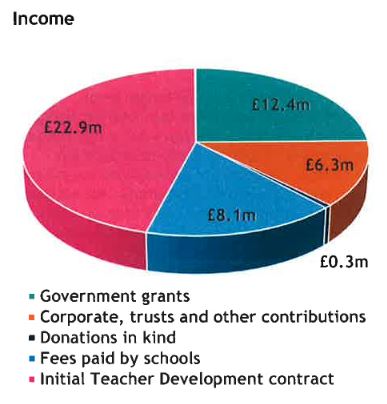
If we now also take into the direct costs to school, the upfront recruitment fee of 4k then it seems that the ‘voluntary contribution per trainee’ is rather low. Of course what is difficult is to unpick what money is actually used internally for what, so let’s also look at the total income of Teach First for 13-14 and 14-15 respectively (this is the 2014-2015 year report for Teach First):
grants2

grants

Simply dividing the total ‘Corporate, trusts and other contributions’ by the total number of new trainees per year yields an amount of £4400-£4800. Of course not all of that might go towards training. According to the online appendices to the first report voluntary contributions for Teach First are £ 1200. Off-setting all of this against aforementioned costs they make a difference but even if we would subtract all the donations and recruitment fees, the costs stay high. I would even say it’s a bit disingenuous to focus attention on these cost types, as it suggests the work is poor (although readily cited in places where the outcome seems more favourable). The cost must be discussed, not downplayed. The last point of the Teach First press release concerns the bursaries. This, of course, is a valid point from the viewpoint of the student. I think the absurdly high costs of the bursary programmes certainly need to be taken into account. But these bursaries are not ‘cost of the programme’ rather a stimulus for individuals. I think that money can be better spent to attract teachers.

The press release finishes with:

teachfirst_press


It is interesting that Teach First uses ‘four years’ because as mentioned previously the IFS reports seems to indicate that it has changed after 5 years. The last point is a variation of incorrect reporting mentioned previously, namely that schools mentioned the benefit; they didn’t they were subject specialist and ITT coordinators in the schools gave a different picture. In an older blog I already criticised the emphasis on ‘value of benefit’ in the 2014 report.

After reading all these sources I would say:

  • Teach First is much more expensive than other routes, even after taking into account school fees, recruitment, first year teaching and donations;
  • Teach First has a much stronger leadership focus than other routes;
  • Retention in Teach First is worse than other routes;
  • There is a shift from TFers working more in ‘requiring improvement’ and ‘inadequate’ schools towards ‘good’ and ‘outstanding’ from year 3 to year 5;
  • The ‘benefit’ from the 2014 IFS report is misreported;

I think Teach First is a valuable route into teaching with passionate leadership and alumni ambassadors (important: criticising cost is not criticising individuals), but it is important to evaluate the overall cost of such a programme (per trainee). Certainly in a time where both provider-led teacher training and school direct programmes have to train with vastly smaller amounts of money (for example 9k for HEI but they normally pay part of this to schools for mentoring), it is realistic to look at ‘added value’ for education. Maybe that is ‘leadership’. Maybe that’s ‘helping the disadvantaged’.  But even if we think those need to be addressed it doesn’t help if retention is low and teachers end up in better schools. Rather than say ‘not a fair comparison’ it would be best to address these aspects head on.

Categories
Education Research

Economic papers about education (CPB part 2)

This is a follow-up post from this post in which I unpicked one part of large education review. In that post I covered aspects of papers by Vardardottir, Kim, Wang and Duflo. In this post I cover another papers in that section (page 201).

Booij, A.S., E. Leuven en H. Oosterbeek, 2015, Ability Peer Effects in University: Evidence
from a Randomized Experiment, IZA Discussion Paper 8769.
This is a discussion paper from the IZA series. This is a high quality series of working papers, but this -of course- is not yet a peer-reviewed journal version. Maybe there is one at the moment but clearly this version was used for the review. Previously I had already noticed there could be considerable differences between working papers and the final version, just see Vardardottir’s evaluation of Duflo et al.’s paper.
booij
The paper concerns undergraduate economics students. Of course a first observation would be that it might be difficult to generalize wider than ‘economics undergraduates from a general university in the Netherlands’. Towards the end it is however argued that together with other papers (Duflo, Carrell) a pattern results is emerging. The first main result is in Table 4.
mainresult
The columns show how the models were built. Column (1) has the basic model with only the mean of peers’ Grade Point Average (GPA) and ‘randomization controls’ are included. Column (2) adds controls like ‘gender’, ‘age’ and ‘professional college’. Column (3) adds the Standard Deviation (SD) of peers’ GPA in a tutorial group. Columns (1) to (3) do not show any effect. Only in column (4), where non-linear terms and an interaction are added, some significant variables appear. This can be seen by the **. The main result seems rather borderline, but ok, in the context of ability grouping it is Table 5 that is more interesting.
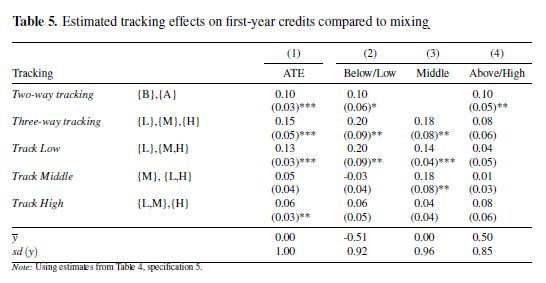
trackingIn that table different tracking scenarios are studied. The first column is overall effects compared to ‘mixed’, so this looks at the ‘system’ as a whole. Columns (2) to (4) show the differentiated effects. From this table I would deduce:
  • In two-way tracking lower ability gain a little bit (10% significance in my book is not significant), higher ability gain a little bit (borderline 5%)
  • Three way tracking: middle and low gain some, high doesn’t.
  • Track Low: low gains, middle more (hypothesis less held back?), high doesn’t.
  • Track Middle: only middle gains (low slightly negative but not significant!)
  • Separate high ability: no one gains.

This is roughly the same as what is described in the article on page 20. The paper then also addresses average grade and dropout. Actually, the paper goes into many more things (teachers, for example) which I will not cover. It is interesting to look at the conclusions, and especially the abstract. I think the abstract follows from the data, although I would not have said “students of low and medium ability gain on average 0.2 SD units of achievement from switching from ability mixing to three-way tracking.” because it seems 0.20 and 0.18 respectively (so 19% as mentioned in the main body text). Only a minor quibble, which after querying, I heard has been changed in the final version. I found the discussion very limited. It is noted that in different contexts (Duflo, Carrell) roughly similar results are obtained (but see my notes on Duflo).

Overall, I find this an interesting paper which does what it says on the tin (bar some tiny comments). Together with my previous comments, though, I would still be weary about the specific contexts.


Categories
Education Research

Unpicking economic papers: a paper on direct instruction

This paper has the title “Is traditional teaching really all that bad?” and is by Schwerdt and Wuppermann makes clear that this paper sets out to show it isn’t. And without this paper I would have said the same thing. Simply because I wouldn’t deny that ‘direct instruction’ has had a rough treatment in the last decades.

There are several versions of this paper on SSRN and other repositories. The published version is from ‘Economics of Education Reviw’, and this immediately shows why I have included it. In the advent of economics papers some have preferred to use this paper rather than a more sociological, psychological or education research approach.

Schwerdt

The literature review is, as often the case in my opinion in economics papers, a bit shallow. The study uses TIMSS 2003 year 8 data (I don’t know why they didn’t use 2007 data).

I find the wording “We standardize the test scores for each subject to be mean 0 and standard deviation 1.” a bit strange because the TIMSS dataset, as in later years, does not really have ‘test scores per subject’ because subjects do not make all the assessment items.

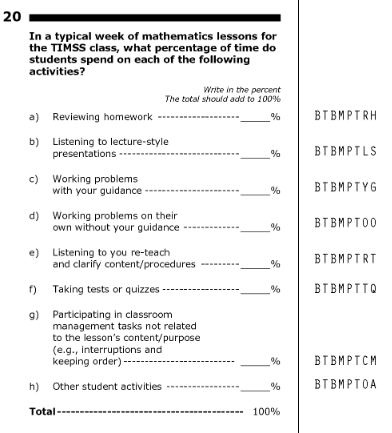
pv(link)Instead, there are five so-called ‘plausible values’. Not using them might underestimate the standard error, which might lead to results being significant more swiftly. This variable is the outcome, another variable is the question 20.

teachThe distinction between instruction and problem solving are based on three of these items: b is seen as direct instruction, c and d together problem solving (note that one of course does mention ‘guidance’). There is an emphasis on ‘new material’ so I can see why these are chosen. Of course the use of percentages means that an absolute norm is not apparent, but I can see how lecture%/(lecture%+problemsolving%) denotes a ratio of lecturing. The other five elements are together used as control. Mean imputation was used (I can agree that imputation method probably did not make a difference) and sample weights (also good, contrary to no plausible values).

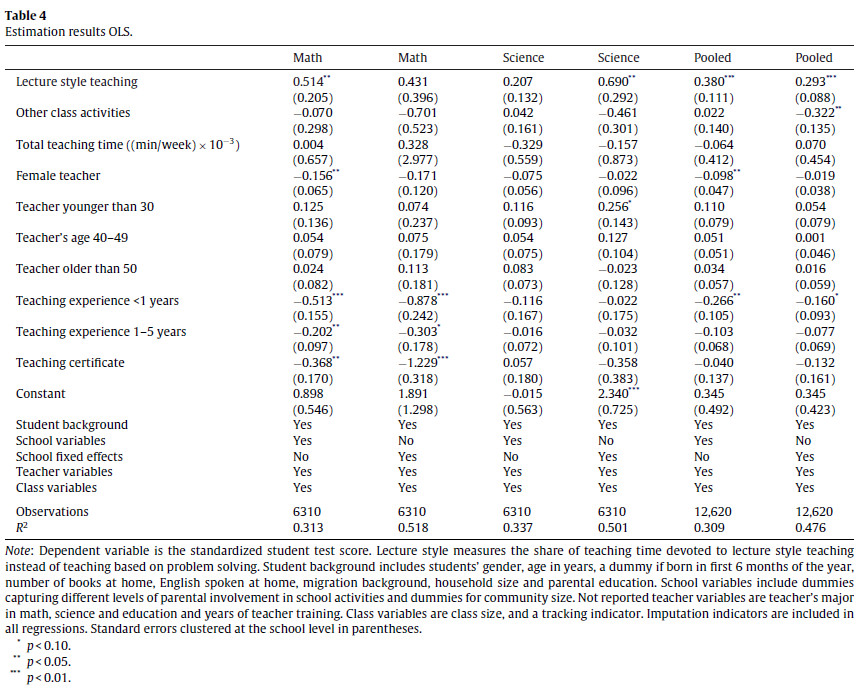
Table 1 in the paper tabulates all the variables and shows some differences between maths and science teachers, for example in the intensity of lecture style teaching. The paper then proposes a model “standard education production function”. In all the result tables we can certainly see the standard p=.10 and again with large N’s this, to me, seems unreasonable. A key result is in Table 4:

lecturingThe first line is the lecture style teaching variable. Columns 1 and 3 show that Math is significant (but keep in mind, at 5% with high N. However, 0.514 does sound quite high) and Science is not. Columns 2 and 4 then have the same result but now by taking into account school sorting based on unobservable characteristics of students through inclusion of fixed school effects. I find the pooling a bit strange, and reminds me of the EEF pooling of maths mastery for primary and secondary to gain statistically significant results. Yes, here too, both subjects then yield significant results. Together with the plausible values issue I would be cautious.

Table 5 extends the analysis.

table5The same pattern arises. The key variable is significant at the questionable 10% level (column 1) and a bit stronger after adding confounding variables (at the 5% level, but again with high N). The articles notices that over the columns the variable is quite constant, but also that it’s lower than the Table 4 results, showing that there are school effects.

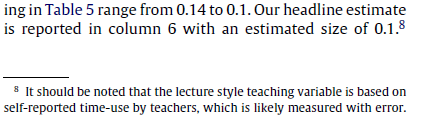
rangeThere is footnote on page 373 that might have received a bit more attention. I find the reporting a bit strange because the first line indicates that variable ranges from 0.11 to 0.14, not 0.14 to 0.1 (and why go from a larger to a smaller number, is this a typo?). Overall, 1% of an SD seems very low. I think the discussion that follows is interesting and adds some thoughts. I thought it was interesting that was said “Our results, therefore, do not call for more lecture style teaching in general. The results rather imply that simply reducing the amount of lecture style teaching and substituting it with more in-class problem solving without concern for how this is implemented is unlikely to raise overall student achievement in math and science.”. Well, that does seem a balanced conclusion, indeed. And again, a strong feature for most economic papers, the robustness checks are good.

In conclusion, I found this an interesting use of a TIMSS variable. Perhaps it could be repeated with 2011 data, and now include all five plausible values (perhaps a source of error). Nevertheless, although I think strong conclusions in favour of lecturing could be debated, likewise it could be said that there also are no negative effects of it: there’s nothing wrong with lecturing!

Categories
Education Research

Unpicking economic papers: a paper on behaviour

One of the papers that made a viral appearance on Twitter is a paper on behaviour in the classroom. Maybe it’s because of the heightened interest in behaviour, for example demonstrated in the DfE’s appointment of Tom Bennett, and behaviour having a prominent place in the Carter Review.

Carrell, S E, M Hoekstra and E Kuka (2016) “The long-run effects of disruptive peers”, NBER Working Paper 22042. link.

disrupt

The paper contends how misbehaviour (actually, domestic violence) of pupils in a classroom apparently leads to large sums of money that people will miss out of later in life. There, as always, are some contextual questions of course: the paper is about the USA, and it seems to link domestic violence with classroom behaviour. But I don’t want to focus on that, I want to focus on the main result in the abstract: “Results show that exposure to a disruptive peer in classes of 25 during elementary
school reduces earnings at age 26 by 3 to 4 percent. We estimate that differential exposure to children
linked to domestic violence explains 5 to 6 percent of the rich-poor earnings gap in our data, and that
removing one disruptive peer from a classroom for one year would raise the present discounted value
of classmates’ future earnings by $100,000.”.

It’s perfectly sensible to look at peer effects of behaviour of course, but monetising it -especially with a back of envelope calculation (actual wording in the paper!)- is on very shaky ground. The paper respectively looks at the impact on test scores (table 3), college attendance and degree attainment (table 4), and labor outcomes (table 5). The latter is also the one reported in the abstract.

table5There are some interesting observations here. The abstract’s result is mentioned in the paper “Estimates across columns (3) through (8) in Panel A indicate that elementary school exposure to one additional disruptive student in a class of 25 reduces earnings by between 3 and 4 percent. All estimates are significant at the 10 percent level, and all but one is significant at the 5 percent level.” The fact economists would even want to use 10% (with such a large N) is already strange to me. Even 5% is tricky with those numbers. However, the main headline in the abstract can be confirmed. But have a look at panel C. It seems there is a difference between ‘reported’ and ‘unreported’ Domestic Violence. Actually, reported DV has a (non-significant) positive effect. Where was that in the abstract? Rather than a conclusion along the lines whether DV was reported or not, the conclusion only focuses on the negative effects of *unreported* DV. I think it would be more fair to make a case for better signalling and monitoring of DV, so that negative effects of unreported DV are countered; after all, there are no negative effects on peers when reported.


Categories
Education Research

Economic papers about education (CPB part 1)

Introduction

It feels as if there has been an incredible surge of econometric papers in social media. Like a lot of research they sometimes are ‘pumped around’ uncritically. Sometimes it’s the media, sometimes it’s a press release from the university, sometimes it’s even the researchers themselves who seem to want a ‘soundbite’. These econometric papers are fascinating. What they often have going for them -according to me- is their strong, often novel, mathematical models (for example Difference in Differences or  Regression Discontinuity Design. I also like how after presenting results there often are ‘robustness’ sections. However, they also often lack a sufficient literature overview; one that often is biased towards econometric papers (yet, it is quite ‘normal’ that disciplines cite within disciplines). Also, conclusions, in my view, lack sufficient discussion of limitations. Finally, I often find that the interpretation of the statistics is a bit ‘typical’, in that econometric papers seem to love to use significance testing (NHST) with p=.10 (yes, I know of criticisms of NHST) and try to summarize the findings in a rather ‘simplistic’ way. The latter might be caused by an unhealthy academic ‘publish or perish’ culture in which we sometimes feel only extraordinary conclusions are worth publishing (publication bias).

Unpicking some economics papers

Some people have asked me what I look for in such papers. In this first blog I will use some papers from a recent report of the CPB, the Netherlands Bureau for Economic Policy Analysis. They recently released a report on education policy, summarizing the effectiveness of all kinds of educational policies. As the media loved to quote on a section on ability grouping, who seemed to say that ‘selection worked’, I focused on that part. It also was the topic of a panel discussion at researchEd maths and science, so it also was something I had looked into any way. The research is mixed. It struck me that, as could be expected from an economic policy unit, the studies were almost all economically oriented. Of course some went as far as suggesting that the review just had high standards and that maybe therefore educational and sociological research did not make the cut (because of inclusion criteria, see p. 330 of the report, in Dutch). This all-too positive view of economic research, and less so of other research, in my view is unwarranted. It has more to do with traditions within disciplines. In this case I want to tabulate some of my thoughts about the papers around ability grouping within one type of education (p. 200 of the report). I won’t go into the specifics of the Dutch education system but it suffices to say that the Netherlands has several ‘streams’ based on ability, but within the streams students are often grouped by mixed ability. This section wanted to look at studies that looked at ability grouping within each of those streams. The media certainly made it that way.

Duflo et al

The study that I recognized, as it featured in the Education Endowment Fund toolkit, was the paper by Duflo et al. It is a study of primary schools in Kenya.

Duflo, E., P. Dupas en M. Kremer, 2011, Peer effects, teacher incentives, and the impact of tracking: evidence from a randomized evaluation in Kenya, American Economic Review, vol. 101(5): 1739-1774.

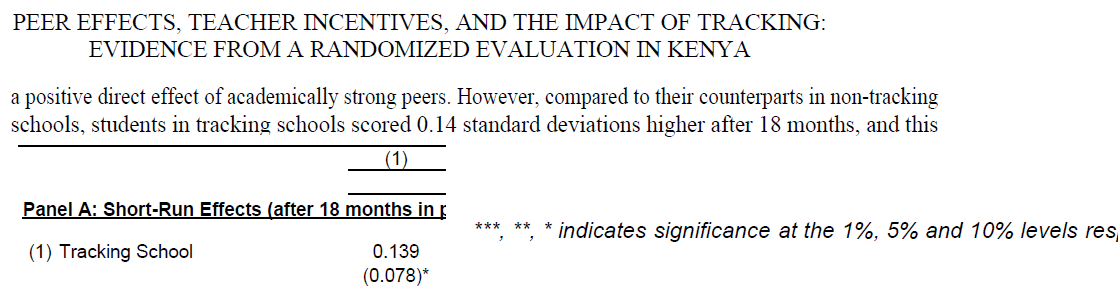
The paper first had been published as an NBER working paper. There is a difference in the wording of the abstracts of working and published paper, but in both cases the main effect is:

duflo

  • Tracking schools scored 0.14SD higher.
  • The result comes from Table 2.
  • But the paper uses 10% significance level to get a significant result. N is large, although number schools -not mentioned in the table- lower.
  • Long-run effects seem stronger but it would be hard to argue nothing else could have influenced this.

In sum, I think we would need to be a bit careful in concluding ‘ability grouping’ works.

Vardardottir

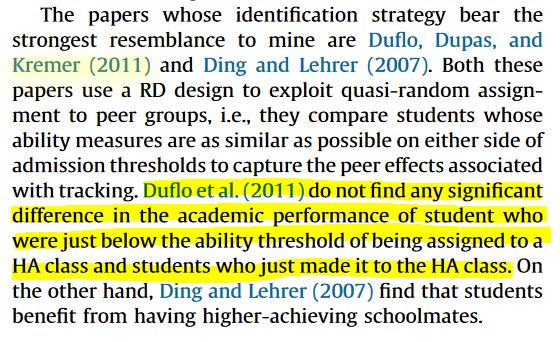
Interestingly, Vardardottir points out the non-significant findings of Duflo et al., although in a preliminary paper there was a bit more discussion about the original Duflo et al. working paper. Maybe this is about different results, but I thought it was poignant.

vardarThe study, conducted in Iceland and in secondary school (16 yr olds) finds “Being assigned to a high-ability class increases academic achievement”. I thought there was a lot of agreement between the data and the findings. The study is about ‘high ability classes’ and the CPB report says exactly that. This seems to correspond with educational research reviews as well: the top end of ability might profit from being in a separate ability group. However, a conclusion about ability grouping ‘in general’ for all ability groups is difficult to make here.

Vardardottir, A., 2013, Peer effects and academic achievement: A regression discontinuity approach, Economics of Education Review, vol. 36: 108-121.

Kim et al and Wang

A third paper mentioned in the report is one by Kim et al.. Another context: secondary school, and one set in South Korea. It concludes that: “First, sorting raises test scores of students outside the EP areas by roughly 0.3 standard deviations, relative to mixing. Second, more surprisingly, quantile regression results reveal that sorting helps students above the median in the ability distribution, and does no harm to those below the median.”. As an aside, it’s interesting to see that the paper had already been on SSRN (now bought by Elsevier) since 2003. This begs the question, of course, from what year the data is. This always is a challenge; peer review takes time and often papers concern situations from many years before. In the meantime things (including policies) might have changed.

Kim, T., J.-H. Lee en Y. Lee, 2008, Mixing versus sorting in schooling: Evidence from the equalization policy in South Korea, Economics of Education Review, vol. 27(6): 697-711.

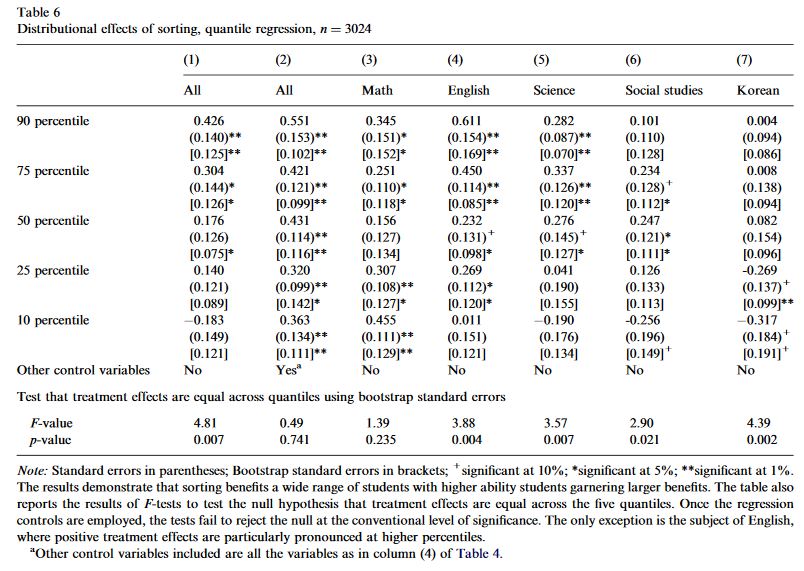
The paper uses ‘Difference-in-Differences’ techniques. I think the overall effect (the first conclusion), based on this approach is quite clear. I personally don’t find this very surprising (yet) as most literature tends to confirm that positive effect. However, criticism to it often is along the lines of equity i.e. like Vardardottir high ability profiting most from this, with lower ability not profiting or being even worse off. Interestingly (the authors also say ‘surprisingly’), the quantile regression seems to go into that:

KimThe footnote summarizes the findings. If I understand correctly, the argument is that with controls, column (2) gives the overall effect per quantile of the ability grouping. This is clear: at 1% significant effects for all groups. The F-value at the bottom tests for significant differences, and is not significant (>.1, yes economists use 10%), hence the statement ‘no significant differences’ between different abilities. Based on column (2) one could say that; we could of course also say that a difference of .320SD versus .551SD is rather large. But what’s more interesting, is the pattern of significant effects over the subjects: those are all over the place in two ways. Firstly, in the differential effects on the different ability groups e.g. in English significantly larger positive effects higher ability than lower ability (just look at the number of *), in Korean significantly more negative effects for lower ability. (Note, that I did see that other control variables weren’t included here, I don’t know why, there is something interesting going on here any way, as there are differences first in column (1) but controls in (2) make them non-significant). Furthermore, the F-values at the bottom show that only for maths there are no significant differences, for all the other subjects there are, some quite sizable. What seems to be happening here is that all the positive and negative effects over the ability groups roughly cancel each other out, yielding no significant difference. Maybe they go away when including controls, but that can’t be checked. What is clear, I think, is that there are differences between subjects. I think the conclusion in the abstract “sorting helps students above the median in the ability distribution, and does no harm to those below the median” therefore needs further nuance.

Therefore it was useful there was a follow-up article by Wang. One thing addressed here is the amount of tutoring: an example of how different disciplines could complement each other i.e. Bray’s work on Shadow Education.

Wang, L. C., 2014, All work and no play? The effects of ability sorting on students’ non-school inputs, time use, and grade anxiety, Economics of Education Review, vol. 44: 29-41.

The article is, however, according to the CPB report premised on the assumption that there are null effects on lower-than-average-ability. Effects that, in my view, already deserve nuance based on subject differences. It therefore is very interesting that Wang looks at tutoring, homework etc. but the article seems to not continue with subject differences. This is a shame, in my view, because from my on mathematics education background -and as stated at that researchEd maths and science panel- I can certainly see how maths might be different to languages. It would have been a good opportunity to also think about top performance of Korea in international assessments, for example. Yet the take-away message for the CPB seems to be ‘ability grouping works’.

Conclusions not warranted?

There are more references, which I will try to unpick in future blogs. These will also include papers on teaching style, behavior etc. all education topics for which people have promoted economics papers as ‘definitive proof’. There also are multiple working papers (the report argues that because some series often end up as peer-reviewed articles any way, they might be included, like NBER and IZA papers.) which I might cover.

Nevertheless, this first set of papers, in my view, does not really warrant the conclusion ‘ability groups work’. Though to be fair, in many cases the abstracts might make you think differently. It shows that actually reading the original source material can be important. Yet, even if we assume they do say this, the justification that follows at the end of the paragraph is strange (translated): “The literature stems, among others, from secondary education and, among others, from comparable Western countries. The results point in the same direction, disregarding school type or country. That’s why we think the results can be translated to the Dutch situation.”. Really? Research from primary, secondary and higher education (that’s the Booij one). From Kenya, from Korea (with its shadow education)?

Final thoughts

What we have here is a large variety of educational contexts, both in school type(s), years and countries, with confusing presentation of findings with, in my view, questionable p-value. OK, now I’m being facetious; I just want people to realize that every piece of research has drawbacks. They need to be acknowledged, just like the strong(er) points. If we see quality of research as a dimension from ‘completely perfect’ (would be hard-pressed to find that) and ‘completely imperfect’, there are many many shades in-between. ‘Randomized’ is often seen as a gold standard (I still feel that this also comes with issues but that is for another blog), yet economists have deemed all kinds of fine statistical techniques as ‘quasi experimental’ and therefore ‘still good enough’. Yet, towards other disciplines there sometimes seems to be a ‘rigor’ arrogance. Likewise, other disciplines too readily dismiss some sound economics research because it seldom concerns primary data collection or they ‘summarize’ data incorrectly. It almost feels like a clash of the paradigms. I would say it depends on what you want to find out (research questions). The research questions need to be commensurate with your methodology, and they in turn both need to fit the (extent of) the conclusions. We can learn a lot from each other, and I would encourage disciplines to work together, rather than play ‘we are rigorous and you are not’ or ‘your models are crap’ games. Be critical of both (as I am above, note I’m just as critical about any piece of research without disregarding its strengths), be open to affordances of both (and more disciplines of course), and let’s work together more.

Categories
Education Research Math Education MathEd

Slides from researchEd maths and science

Presentation for researchED maths and science on June 11th 2016.

References at the end (might be some extra references from slides that were removed later on, this interesting 🙂

Interested in discussing, contact me at C.Bokhove@soton.ac.uk or on Twitter @cbokhove

Categories
Education Education Research Math Education MathEd

Presentatie researchED Amsterdam (Dutch)

Dit is de researchED presentatie die ik gaf op 30 Januari 2016 in Amsterdam. Enkele Engelstalige woorden zijn er in gelaten. Literatuur is aan het einde toegevoegd.

Categories
Entertainment Movies Music

David Bowie

Bowie has passed away.

I did not like all his music. I was brought up with Let’s dance and the (wonderful) This is not America (from The Falcon and the Snowman, if I recall correctly). He also had a mediocre Drum & Bass outing.

My favorite band in my younger years was Suede. They were heavily influenced by Bowie. They made me look into Bowie’s Berlin period, which to me still is his best period. That and Ziggy Stardust.

I did not like all the newer stuff.

Bowie had the biggest influence on me with just one of his films (yes, of course we watched Labyrinth with the kids): Merry Christmas Mr. Lawrence. An impressive movie with similarly impressive music. The butterfly on his face will never be forgotten. This is the famous ‘kiss’ scene:


Categories
Education Math Education MathEd Tools

Marbleslides

As some may know I’ve had an interest in technology for maths for quite some time now. Because of this I am very aware of what the developments are. One of the latest offering from the wonderful online graphing calculator from Desmos, consists of their ‘activities’. Although every maths teacher should stay critical with regard to integrating ‘as is’ activities in their classrooms, I also think they should be aware of this fairly new feature. That is the reason I flagged it up during some ‘maths and technology’ sessions I ran for the maths PGCE. But always as critical consumers.

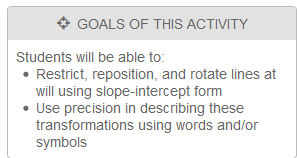
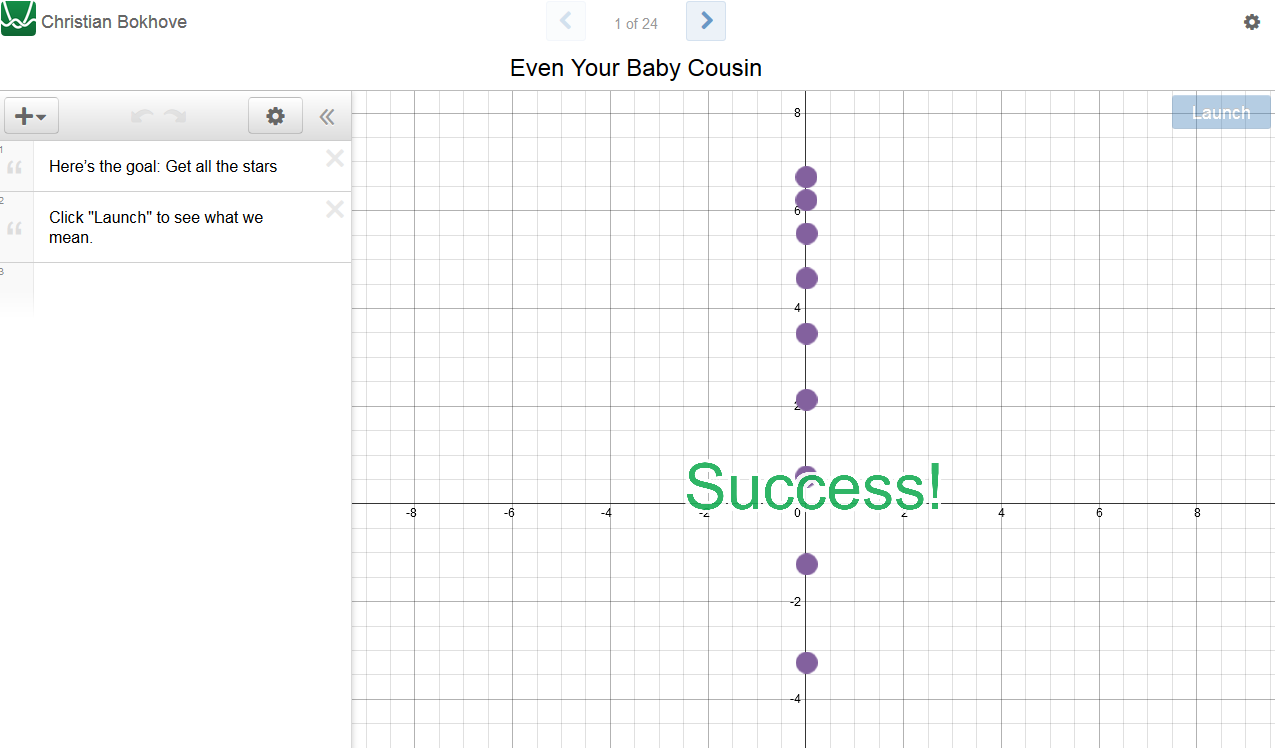
One of the latest offerings is the Marbleslides activities. I first read about it on Dan Meyer’s blog. There are several version of it, with linear functions, parabolas and more. As always the software is slick and there is no doubt the ‘marble effect’ is pretty neat. It reminds me of a combination of ‘Shooting balls‘ (linear functions, Freudenthal Institute, progressive tasks), ‘ Green globs‘ (functions through the globs) and also the gravity aspects of Cinderella. It has already been possible to author series of tasks with the latter widget. I first tried the ‘marbleslide-lines‘. The goals of the activity are:

desmos1
The activity starts off with some instruction on the use of it. Many questions arise:

  1. Why do the marbles start at (0,7) ?
  2. Are the centers of the starts ‘points’? (this becomes important later on)
  3. Why several marbles? Why not one?
  4. Why do the marbles have gravity?
  5. How much gravity is it? 9.8 m/s^2?

Clicking launch will make the marbles fall and because they fall through the stars ‘success’ is indicated.

desmos_p1

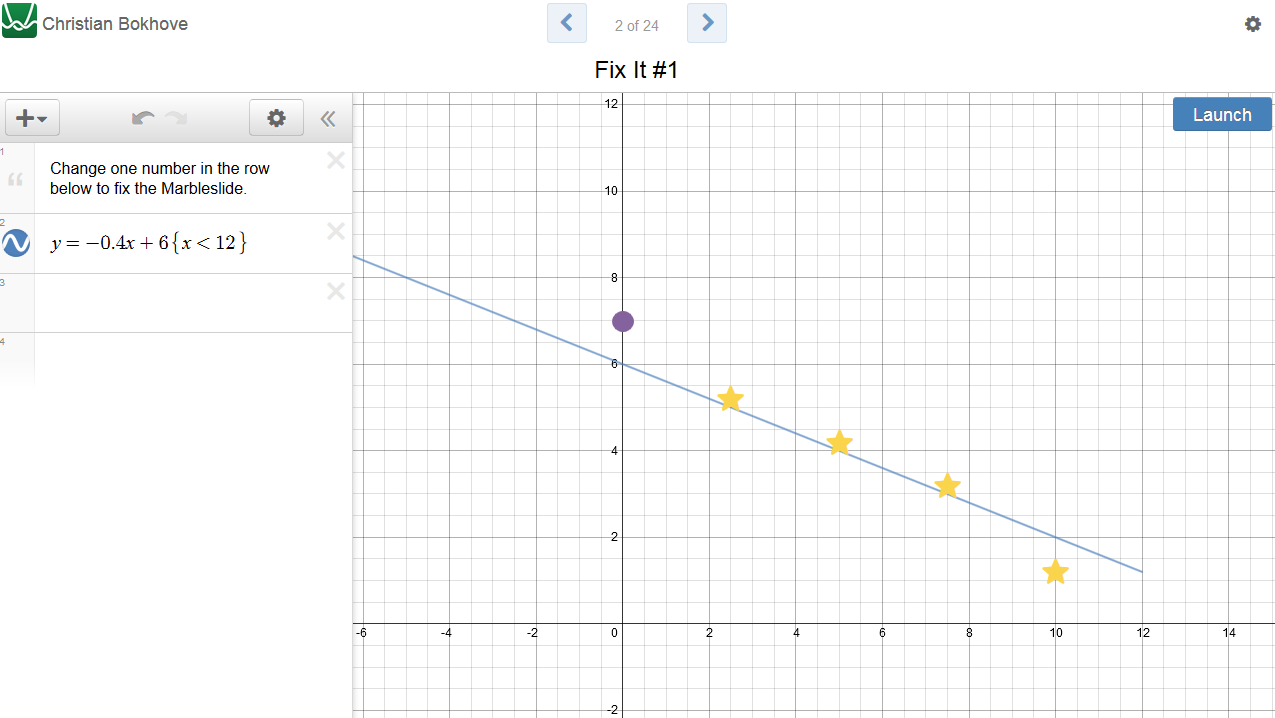
I am already thinking: so is the point to get through the points or the stars? And if gravity is at play, does that mean lines do not extend upwards? Any way, I continue to the second page, where I need to fix something. What is noticeable is 1. yes, the marbles again are at (0,7), 2. the line has a restricted domain, 3. the star to the right is ‘off line’. I’m not much more informed about the coordinates of the star, which leads me to assume they don’t really matter: it must be about collecting them. ‘Launching’ shows the marbles only picking up only two of the stars (for movie, see here).

desmos_p2The line has to be extended. The instruction is “change one number in the row below to fix the marble slide”. A couple of things here: what is there to fix? Is something really broken? The formula has a domain restriction. Do we really want to use the terminology of this domain being broken? I removed the domain restriction. This is ‘just’ a normal line. But it doesn’t give all the stars so ‘no success’. Restricted to x<12 no. For x<9 marbles shoot over. x<7 and there is success.

desmos_p2_2This is very much trial and error, partly caused by the gravity aspect.

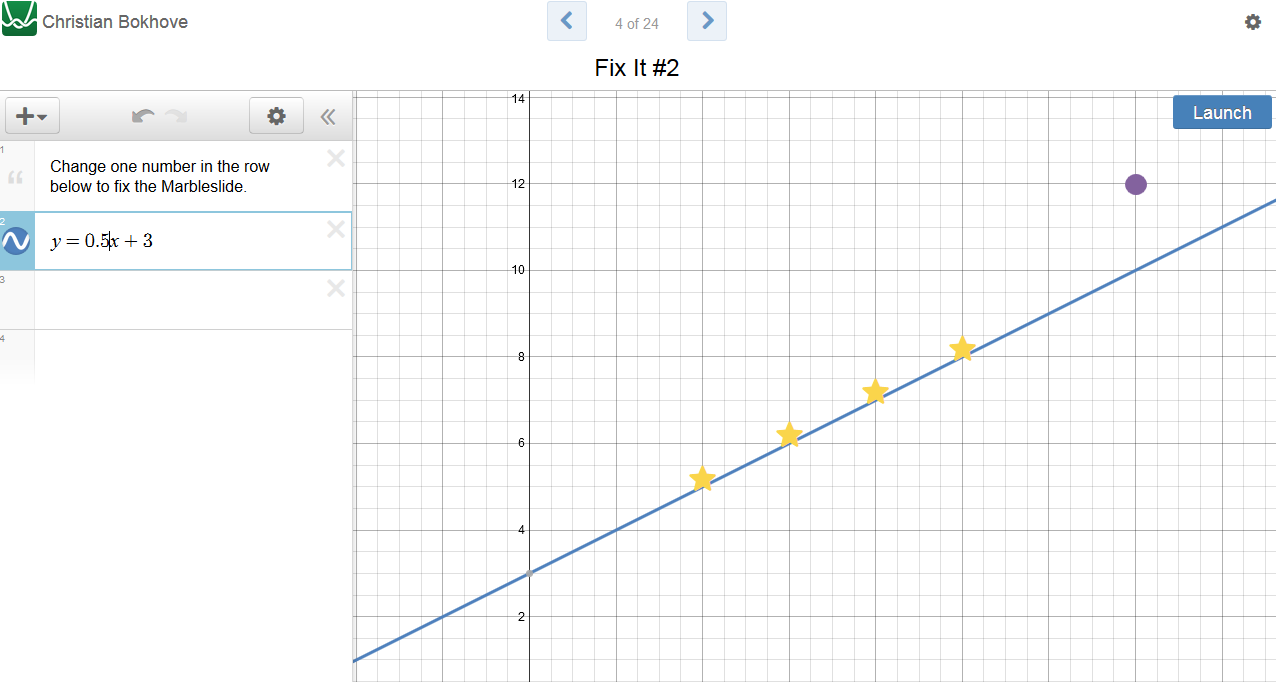
On page 4 there is a more conventional approach: there is a line with a slope. The prior knowledge indicated in the notes mentions y=mx+b should be known: “Students who know a little something about domain, range, and slope-intercept form for lines (y=mx+b)”. I wonder why this terminology is not used then. Again the formulation of the task is “change one number in the row below to fix the marble slide”.

desmos_p3Because it’s relatively conventional I guess the slope is meant. But am I meant to guesstimate? Or use the coordinates? Does it matter? I first tried 1 (yes, I know that’s incorrect) and I just keep on adjusting.

desmos_p3_2

0.5 seems ok, but 0.45 is ok as well, even 0.43. 0.56 does as well, but 0.57 misses a star because the line runs above it. May I adjust the intercept? I can, so this again promotes trial and error over thinking beforehand, in my opinion. In addition, it does not instill precision.

On page 5 the same thing but now for the intercept.

desmos_p5I’m still curious why the terminology of y=mx+b isn’t used. I guess -2 is expected as nicest fit but I can go as far as -2.7 to get ‘success’, yet -1.4 is ‘no success’. This could be seen by the teacher, of course (well, we can make any confusion into an interesting discussion, of course). It is interesting to see the marbles now start from higher up, by the way. The gravity question becomes more pertinent. How much gravity? And there is a bounce, surely the bounce is more if the gravity or hight is greater? Or not? Apart from the neat animation, what does it add?

Then on page 6 we go to stars that are not on one line (surely too quick?). There again are several answers, which in my opinion keeps on feeding the idea that points (but sure, they are stars) do not uniquely define a line.

desmos_p6From page 7 predictions are asked when numbers are changed. There still is no sign of terminology. It is a nice feature that the complete Desmos tool can then be used to check the answers. This is about functions, unlike the marbles section. Why is the domain still restricted, though? Throughout the tasks it seems as if domain and range are modified to suit the task, rather than a property of functions. Granted, a small attempt to address it is in page 11.

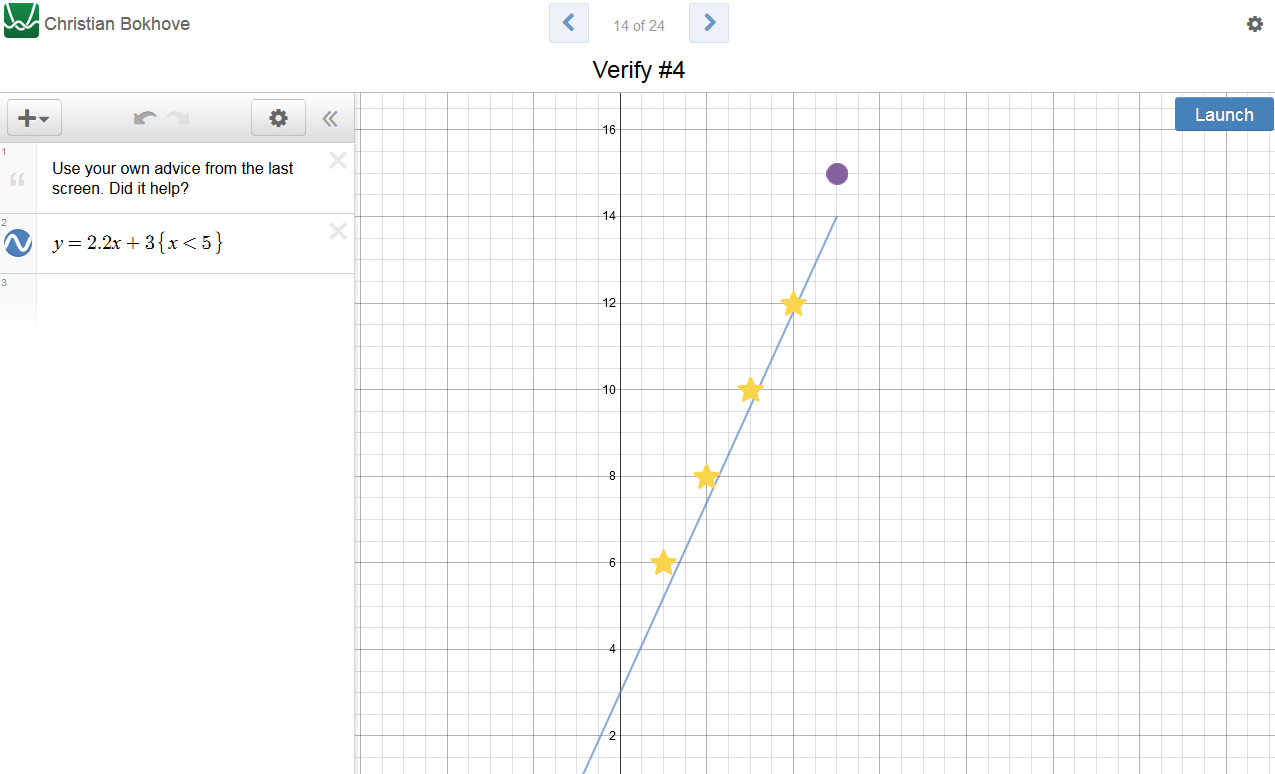
On page 13 the stars are back again. The first attempt with whole numbers is exactly right y=2x+4{x<5}. Some marbles fell to the right of the line though. Nevertheless, there was ‘success’. But there also was success on page 14 like this:

desmos_p14_2From page 15 there are challenges. The instruction says to “Try to complete them with ONLY linear equations and as FEW linear equations as possible.” These are a lot of fun, but I struggle to see the link to slope-intercept form y=mx+b. It is not mentioned explicitly. There is no real attempt to link to the terminology. I fear it will remain a fun activity with a lot of creative trial and error.

desmos_p17I’ve also looked at the parabolas activity. The same features are apparent here: functions are collections of points (rather: stars) and functions have to be found that go through them. The assertion is that transformations of graphs are somewhat addressed concurrently, but the trial and error aspect makes me doubt this. It also deters from general properties of graphs like roots, symmetry, minimums, maximums. I can see a role for playful estimates but in my opinion they must be anchored in proper terminology, precision and properties of graphs. Furthermore, I was inclined to sometimes just use lines. There was no feedback as how this was not permitted. One could even say a line also is polynomial, so why wouldn’t I. The trial-and-error nature might further incentivise these creative solutions. Great, of course, if you know transformations already but not if the activities are meant to strengthen skills and understanding (did I ever say they go hand in hand? 🙂

Some of these aspects might be mitigated by the editing feature that will be released soon, but surely not all answers to fundamental but friendly critique will be “do it yourself”? Another nice feature of course, also in other software, is that you can see student work. Yet I feel with some of these fundamental issues not properly addressed, misconceptions might arise. I think that the marble animation is at risk of obfuscating what the tasks should be about. It might lead to more engagement (fun!) but if it does not lead to learning or even might lead to misconceptions, is that helpful? Firstly, I think the scaffolding of tasks should be more extensive with a clear link to maths content. Secondly, I would reconsider the confusion between ‘points on a line’ and ‘stars to collect’. I hope Desmos can iron out some of these issues, because one thing is sure: the falling marble effect remains a joy to behold. However, pedagogically, I think as it stands it needs to be developed further.

Categories
Education Research

Research on teaching in Higher Education

I recently have been doing a lot of thinking on the Teaching Excellence Framework. For this reason any blog article that talks about quality of teaching in HE is interesting to me. For example the Times Higher Education article on a study which suggests that “students taught by academics with teaching qualifications are more likely to pass, but less likely to get first-class scores.” The underlying study is this one. I was very surprised to read this article. The article compares teachers with only a PhD and teachers with a PhD AND a teaching certificate (all other types were disregarded).  In my opinion there are several big problems with the study, some demonstrated by one of the central table:

diff

What immediately is apparent:

  • There are no significant differences between PhD and PhD-TeacherCert, as the last column demonstrates (yes I know the limitations of p-values, but the article actually refers to them).
  • Look at the numbers: with such low numbers you can really not make the inferences any way.
  • There is a particularly hard to understand paragraph to argue that we can’t just say that ‘2% versus 5% non-pass might not seem much’ (top line). Well, it isn’t much, so I can’t see how one can argue the opposite.
  • I like it even less that then these highly contentious results are used to suggest two types of teachers, not unlike how glossy magazines do, ‘damage controllers’ and ‘perfection seekers’.
  • The study calculates a ‘group GPA’ for every module which is seen “metric to evaluate the quality of learning from Units”. What? Grades as a metric for quality without regarding other elements like assessments?
  • The group GPA was calculated by converting scores to a Likert scale, in what to me seems a rather arbitrary manner. Luckily this was deemed a little bit ‘contentious’ by the authors.

But there is more:

  • There is almost no development of a framework. After half a page of abstract, there is half a page of introduction and then it’s straight on into the research question and methodology.
  • The limitations section was 2 (two!) lines long, only reporting on how qualitative data was not collected.
  • As a consequence the article is a mere 7 pages. I love concise articles but this is a bit too extreme. On the upside, I assume this journal likes such short articles.