Categories
Education

My take on a new College of Teaching

A lot has already been said about the proposed new College of Teaching (CoT). Up until now I have only devoted tweets to the topic, and because it might almost seem as if I’m against such a college, I thought it would be good to write this post. Let’s say I’m positive but politically skeptical. One thing that certainly has become apparent that there is quite some momentum it seems, within the teaching community itself. I even became very enthusiastic about the passionate posts by David Weston and Tom Bennett

Initial depicting Boethius teaching his students from folio 4r of a manuscript of the Consolation of Philosophy (Italy?, 1385)

(and more at Claim your College). Also, the run-ins I had with Andrew Old were helpful, and showed a drive to make it work. The main discussions center around who could join the CoT and what the CoT would do.

Who could join?
There was some discussion about what teachers were envisaged. Although I initially thought a broad group of teachers should be able to join, after all teaching takes place at many levels, I was convinced by the argument that indeed some sub-groups already have opportunities or can create opportunities themselves. For example, although I have been a secondary school teacher for 14 years, now I’m a teacher/lecturer in HE. Well, the Higher Education Academy is for me then (unfortunately, their funding has been cut considerably), and they provide CPD and certification. So, yes, I can see a good case for a professional body for only schoolteachers, and it could contribute to a stronger professional identity within the sector. It could also certainly play a strong role in CPD and other professional development.

Dangers exaggerated
Mind you,  I think the dangers of allowing a wider group of ‘teachers’ to join have also been exaggerated. I’ve seen words suggesting that outside groups might ‘dominate’ the CoT. I firstly wonder on what evidence this statement is based, as it does fit too easily in a caricature of an educational establishment trying to keep education in a hold.  A caricature which is often ‘proven’, ironically, by providing anecdotal evidence which doesn’t stand the test of reasonable social science research. More importantly, I think that even if this was the case I think the presence of lobby groups will not be any less with or without these groups, just different. I think most organizations eventually will ‘suffer’ from lobby or dominant groups. I don’t think it will be any different in a CoT. Vocal bloggers express their opinion? They might very well be dominant. Some teachers are Google teachers, Apple educators etc. They might very well be overly positive towards technology and be influential. I think any organization gets the audience it deserves.

Teacher Training (Education!) and politics
My main point of political skepticism concerns the function of the CoT. Most people who wrote about it assumed that the CoT would be a ‘professional body’. I, however, am a bit concerned that some groups, especially the government, will see the CoT as something more. In the consultation document by the government the foreword explicitly mentions initial teacher training. Under initial functions in 2.9 it mentions “This might include functions that are presently exercised by the Secretary of State, or other roles undertaken by the Department for Education or the National College for Teaching and Leadership (NCTL) in relation to teacher training and development.”. Especially, the ‘in relation to’ at the end begs the question what functions are meant. The NCTL has the following responsibilities:
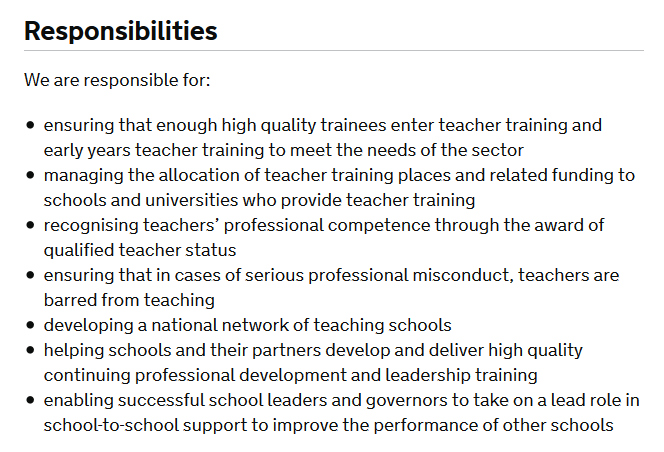
nctlNow, if the first two bullets are representative of what the government means with ‘in relation to teacher training and development.’ then to me it’s clear that more stakeholders than ‘schoolteachers’ are involved. Especially the allocation of teacher training places surely is a joint responsibility. I think it would be very undesirable if a new CoT would decide over this unless the brief and membership of it would include all the relevant stakeholders. It would also fly in the face of what Sir Carter mentions in the introduction of the recent Carter review of initial teacher training: “The truth is that partnership is the key.”. The review mentions more critical points for the future, for example in recommending that a future CoT might “develop a framework for core content for ITT”. Again, I would feel it inappropriate if a professional body of only teachers would decide on this when multiple routes into teaching need to be represented.  If anything, the government’s response to the Carter Review seems to agree with a big role in all of this for a new CoT. It is this prospect of perhaps some formal decision powers on Teacher Training which might cause the  CoT to become a political pawn. It is no secret that a school-led teacher training has been the main focus of the government, and this has led to the closure of some university providers. I think a CoT should try to prevent being used as a political pawn and should clearly state that they acknowledge that Teacher Training is a partnership affair which doesn’t mean that a professional body of schoolteachers alone decide on it.

So to summarize:

  • I’m positive about a professional body for schoolteachers. I agree that a restricted scope of ‘members’ could help build the profession and build a professional identity.
  • I’m skeptical about statements which imply that a restriction of membership is needed to prevent some forces to become too dominant. Like any organization this will happen any way.
  • If the College of Teaching gets formal powers (from the NCTL for example) for Teacher Training, then the scope should be broadened and include all stakeholders involved in Teacher Training.

Other comments
The current, most extensive blueprint for the CoT is based on documents from the Prince’s Teaching Institute.
The Teacher Development Trust also has written plans.
Both look pretty extensive and good but don’t really address the point of Teacher Training.
I also think that one critical point will be whether such a CoT would have anything to do with prescribing Standards or not. Maybe more on this in later posts (then again, maybe not).
Categories
Education Research Research Statistical Methods

Costs and Benefits of Initial Teacher Training Routes

Only recently did i manage to read the November 2014 report published by the Institute of Fiscal Studies (but joint with the Institute of Education and NFER, funded by Nuffield) on the Costs and Benefits of Different Initial Teacher Training Routes. It is an interesting read; it would go too far to comment on all of the content, but it was striking that different media outlets chose different ‘slants’ on the report.

IFS had quite an extensive press release highlighting several aspects, while the NFER chose three of the findings. The report is an interim report from a Nuffield project (I noticed Nuffield funds the IFS for more ‘public spending’ projects).

It is fascinating to see how outsiders reported or blogged about the results. John Howson seems to emphasize the monetarization and quantification of ITT routes. I agree with him that this could turn into an issue: it’s shouldn’t solely be about numbers. However, for public justification of expenses in principle it is important to explain how public money is spent. The Public Finance website had quite a factual report, and among other points, noted how the issies around student loans and repayments. The University and College Union (UCU) also picked up this point but, in my opinion rightly so, asks attention to the longterm effects of the changing ITT landscape, and the hidden costs involved. They emphasize the threat to university education departments caused by reducing the direct allocation of training places to universities. A school-based teacher training provision prefers to highlight (and not suprisingly agree with) the result that a higher percentage of school-based ITT responded that the benefits of the route outweigh the costs. In a more extensive piece in Academies Week many of all these findings come together in one piece. It also mentions the ‘benefits’ of ITT routes. As this also got a mention in some tweets at the time, I’d thought I’d look into how this benefit (and costs of course) was determined in the report.

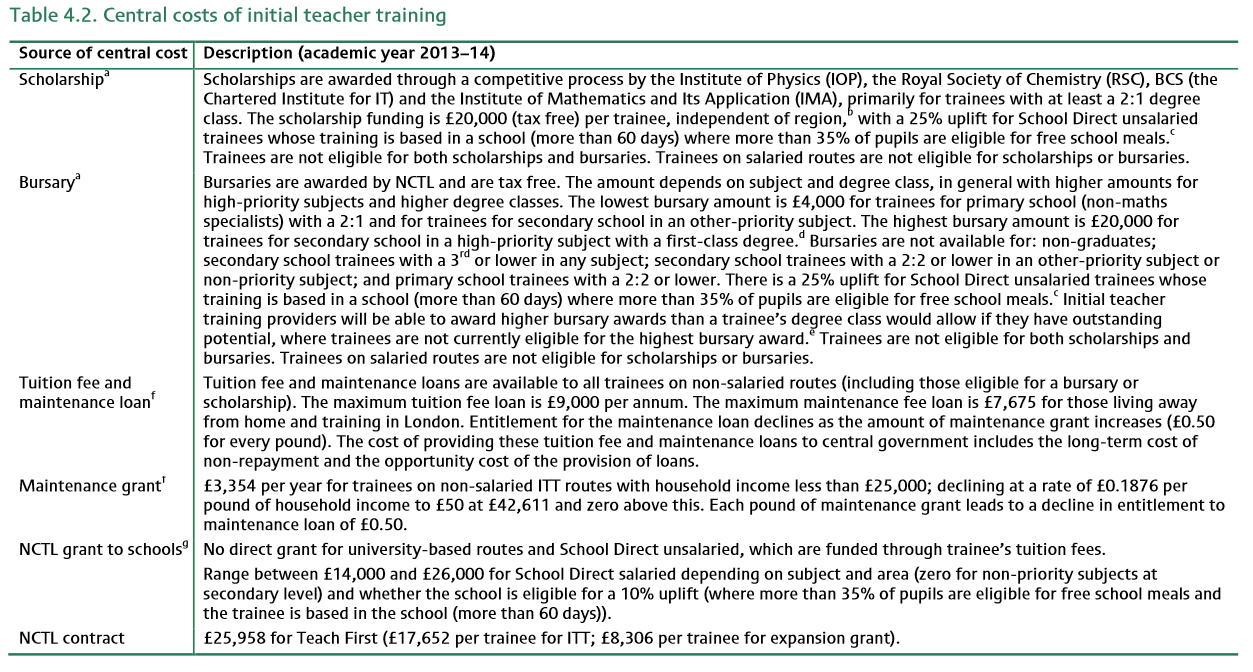
Chapter 4 of the report breaks down this topic. It first addresses the ‘central costs’ in 4.1, in which scholarships, bursaries, tuition fees and maintenance loans, maintenance grants, NCTL grants to schools, and NCTL contracts are taken into account. The key table is below. I was wondering who the recipients of these costs were throughout the report. For example, a bursary will be received by a trainee, a tuiton fee loan paid (back) by students but going to HEI’s etc. etc.

t42

After this the indirect costs for schools are caclulated in 4.2. Note that throughout the report focus is ‘Inner London’, but both primary and secondary education are looked at. This was done by, per term for primary and secondary education, looking at costs for mentoring, observations, lesson planning and other costs. This is where I feel the estimates become a bit vague. The estimates for the costs were obtained by asking respondents to report the time involved with the indirect costs associated with a specific trainee. This was combined with information on the pay category of the lead staff member involved, also representing the ‘opportunity costs of training’. The largest cost associated with ITT for primary schools is mentoring, with an average cost of around £39 per week. For secondary schools the highest was ‘observations’ and I was struck by the difference between routes: Teach First costs £29 per week, HEI-led £81 per week. I seriously wonder how this can be the case. It certainly explains the secondary schools differences in table 4.5 below.

t45Section 4.3 then describes the benefits. I was particularly interested how the report would calculate (monetize) the benefits. Apparently it started with a simple question: respondents were asked to report the extent to which the specific trainee in their recent experience brought a number of benefits to their school/department. These benefits, and percentages ‘strongly agree’ or ‘agree’ are reported in tables 4.7 and 4.8.

t47t48The monetary value was calculated by asking an additional question “whether the benefit for their school or department was greater than, equal to or less than the cost associated with the route, and whether this was to a ‘large’, ‘some’ or ‘small’ extent. Now, this seems somewhat subjective, maybe captured by the report’s use of the word ‘perception’.

t49

For primary, it is reported, whether it is reported that benefits outweigh the cost is related to specific benefits, especially whether the school expects to hire the trainee. This seems understandable, because you would want a large (time and money) investment not to leave the next year.

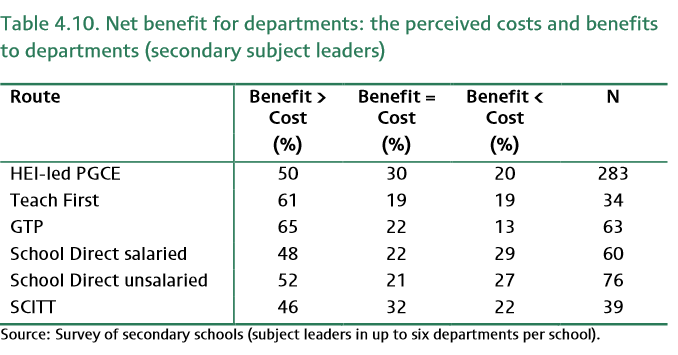
For secondary to groups of people were asked: secondary subject leaders (Departments) and secondary ITT coordinators.

t410

t411

This is all quite informative, although interpretation is difficult. It’s the subsequent monetarization that made me scratch my head. This started with assuming that net benefit was a continous variable with the answers to the question whether the benefits were less, equal or larger and the extent, as underlying property. A next assumption then is that the benefit-cost ratio has a Gamma distribution. It is argued that ‘this is reasonable’ as it is flexible and because ‘it can approximate a large range of distributions depending on the parameters.’. I find this justification unconvincing. But the assumptions continue with the assumption that respondents’ interpretation of ‘large’, ‘some’ and ‘small’ extent is similar AND that the value for each is the same above and below benefits=costs. A final assumption concerns a margin of approximation (see p.49 and appendix D of the report). Then the gamma distribution was fit to the survey results, and then draws made from the optimal gamma distribution. The draws were averaged to provide average net benefit. For the three groups, primary, seocondary subject leaders and ITT coordinators the corresponding tables are 4.16, 4.17 and 4.18:

t416

t417

These tables seem to show what these assumptions do with the results. Take Teach First, the report mentions that, for ITT coordinators, the very high average net benefit is mainly caused by higher monetary costs as reported by the ITT coordinators, but also a higher estimated benefit-cost ratio. I thought the former was very strange as table 4.6 seemed to indicate that the costs were among the lowest. I find it difficult to understand what causes the difference between these observations. This is important to understand as high costs, combined with high benefit-cost ratio, imply more benefit. The calculation of the ratio also needs to be unpicked. I somehow feel that there are far too many assumptions here for such a conclusion, especially given the nature of the original questions. One could argue that it basically is a 7-point Likert scale with benefits to large extent less than costs, to, benefits to large extent more than the costs. With assumptions that these ‘steps’ are equal, Gamma distrubution assumptions, but also that it concerns the perception of benefits-costs ratio, seems problematic to me. Appendix D further explains the procedure and it seems that the first column is the average of the calculated benefit-cost ratios (those drawn from the Gamma distribution, I presume). It makes a big difference whether values are drawn to the right of the distribution or not. Now had I taken from table 4.11, for example, that benefits>cost percentage for HEI-led ITT was comparable to, for example Teach First. I have no idea why the benefit-cost ratio is lower. Overall, given all the assumptions I think the net benefits reported in terms of ‘monetarization’ are not really sound.


Categories
Math Education MathEd Research

BSRML conference – report

I have written three posts on the BSRLM day conference on November 17th, 2012.

The three posts are:

BSRLM conference part 1
BSRLM conference part 2 Alnuset
BSRLM conference part 3

Categories
Math Education MathEd Research

BSRLM conference part 3

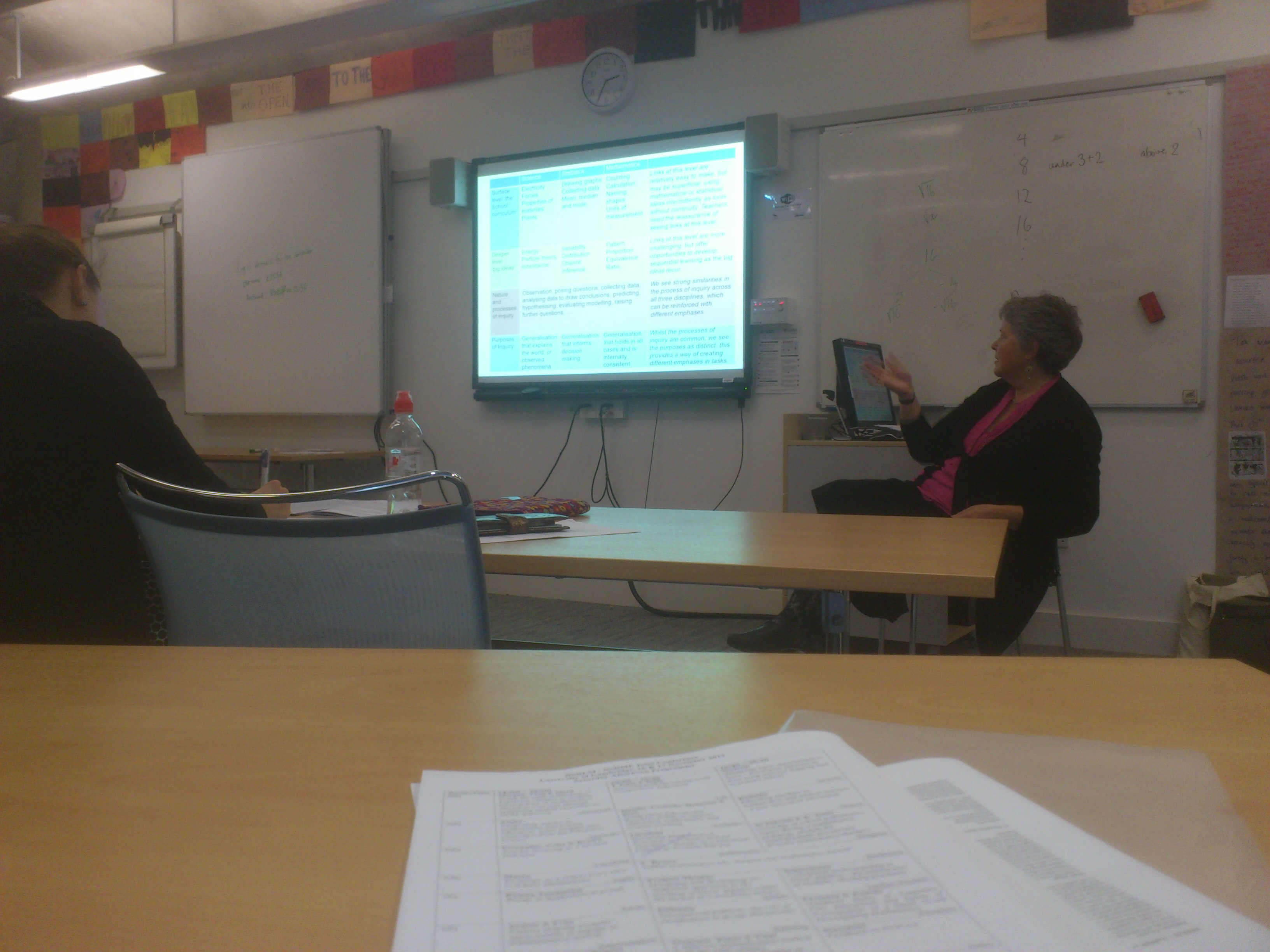
The fourth session by Ainley reported on the Fibonacci project, integrating inquiry in mathematics and science education. It was good to hear that the word ‘utility’ that was used, did not refer to a utilitarian view of maths, i.c. that everything should have a clear purpose. I mention this as discussions about utility often tend to end in comments like ‘what’s the point of doing algebra’? Actually, I think that does have a purpose, amongst others ‘analytical thinking’ but I prefer steering clear from these types of pointless discussions. The best slide, I though, was a slide with science, statistics and mathematics in the columns and rows with a distinction in, for example, their purpose.

It formed a coherent picture of STEM. The two examples for integrative projects were ‘building a zoo’ which I didn’t like when it concerned the context of fences that had to be built. It’s the lack of creativity that often is in textbooks as well. the second project, on gliders, was more interesting but the mathematical component seemed to belong more in statistics used. I would loved to have seen a good mathematical example.

The fifth session by Hassler and Blair was about Open Educational Resources. The project, funded by JISC, acknowledged three freedoms: legal, technical and educational. It is a project that boasted a website with educational resources, free to use, keywords and with pdf creator. Although nicely implemented, to me, it seemed to be a bit ‘yet another portal’. The individual elements weren’t that novel either, with for example a book creator also in the Activemath project. The most interesting thing was the fact that the materials were aimed at ‘interactive teaching’.

The sixth and last session was a presentation by Kislenko from Estiona. She described how in Estonia a new curriculum was implemented for educating teachers in mathematics and natural sciences. It was an interesting story, although I was wondering how ‘new’ it was, as the title had the term ‘innovative’ in it.

Together with some networking these sessions made up an interesting and useful day in Cambridge.

Categories
ICT Math Education MathEd Research Tools

BSRLM conference part 2 Alnuset

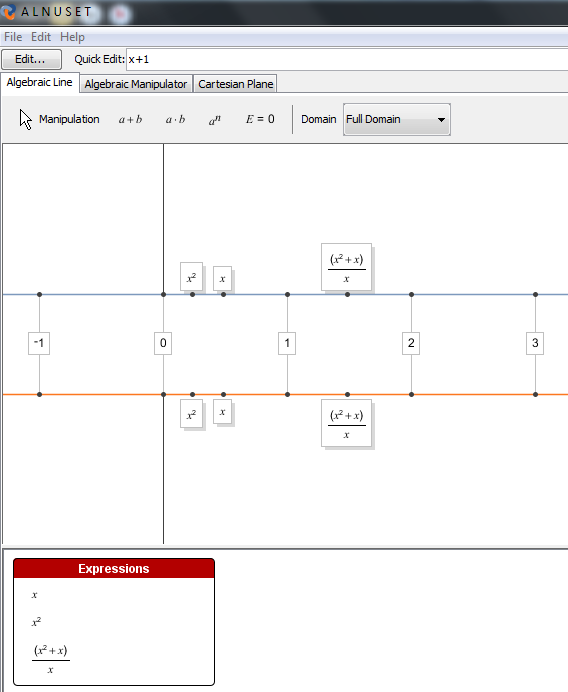
The third session I attended was more a discussion and critique session, led by Monaghan and Mason, on the topic of ‘cultural affordances’. The basis was the work of Chiappini, who -in the ReMath project- used the software program Alnuset (see here to download it) to look at (its) affordances. Monaghan described the work (a paper on the topic, there will be a publication in 2013, was available) and then asked some questions. Chiappini distinguishes three layers of affordances: perceived, ergonomic and cultural. Engestroms cycle of expansive learning is used, as I understood it, to use activities as drivers for transformation of ergonomic affordances into cultural affordances. Monaghan then asked some critical questions, under which whether the theory of Engestrom really was necessary, wouldn’t for example Radfords work on gestures be more appropriate? Another comment pondered whether the steps for expansive learning were prescriptive or descriptive. I think the former: as the author has made the software with certain design elements in mind it is pretty obvious that they have a preconceived notion of how student learning should take place.  It was pretty hard to discuss these more philosophical issues in detail. I’m not really sure if I even understand the work. Although this could be solely because I haven’t read enough about it, I also feel a bit as if ‘difficult words’ are used to state the obvious. I could only describe what I was thinking off. The article that I took home afterwards gave some more pointers. To get a grasp of this I downloaded the software, that reminded me a bit of the Freudenthal Institute’s ‘Geometrische algebra’ applets, and tried out the software. I liked the idea behind the software. In this example I’ve made three expressions, and I can manipulate x. The other two expressions change with x. Some comments:

  1. I like the way expressions are made and the look and feel, as well as the way dragging changes the expression. Also ‘dividing by zero’ causes expressions to disappear. However, why does x=0 disappear as well when I drag x to 0? (see figure)
  2. I don’t see how the drawback of every tool that allows ‘dragging’, namely just pointless dragging, in this case just to line up the different expressions, is solved. Maybe this isn’t the main goal of the software.
  3. I think that the number line should be used in conjunction with tables and graphs, thus forming a triad expression-table-graphs. The addition of things like an algebraic manipulator and a Cartesian plane seems to indicate that the authors also like more than one representation.
  4. It has far too limited scope for algebra. The 30 day trial is handy here, as in my opinion the software doesn’t do enough to warrant the price.
Categories
Math Education MathEd Research

BSRLM conference part 1

On Saturday November 17th I visited the second day of the BSRLM conference (British Society for Research into Learning Mathematics). I’ve become a member as it’s ‘the place to be’ for maths education research. This time the conference was in Cambridge, and apparently I was the only one tweeting #bsrlm.

The first session I attended was by Anne Berit Fuglestadt from the university of Agder (soon, homebase of a Dutch researcher I know). She reported about teachers discussing inquiry-based teaching with digital tools.

The second half of the session consisted of discussions on instrumental and documentational genesis (The French School, Trouche is an important name). This was fitting, as one PhD student I (co-)supervise is studying instrumentation as underpinning framework for her study.

The second session was an interesting take on use of the Livescribe pen. At first it seemed as if the study, done by Hickman and Monaghan, seemed a bit of a waste of the livescribe pen. Emphasis was put on the audio recording facilities.

Luckily, as I could have expected, they did more with the pen. The pens were used to record student work while ‘thinking aloud’ and these materials (a sort of screencasts of what was written) were used for a combination of stimulated recall and task-based interviews (e.g. Goldin, 1997). Hickman showed some discourse by primary students that was recorded with the pen. It was nice to see student work being ‘constructed’ instead of just having static scans of their work. It also was nice that we could try out the pen ourselves. I did think more can be done with even the older generation of pens. For example, Dragon Naturally Speaking does doe a decent job of transcribing voice, just as long as it is trained to recognize it. It will certainly cut the amount of time you need for transcribing an hours worth of audio.

Another application to use would be Myscript, from the same company that brings a great online equation recognizer. The latest version of the pen also boasts Wifi and Evernote integration, so it looks interesting. It will certainly be worthwhile to check out this for our SKE+ group. A follow-up discussion could be whether these devices will eventually become obsolete if tablet technology with styli, like the Galaxy Note, takes off.