Categories
ICT

Mitra, genius or?

Source: http://www.flickr.com/photos/campuspartybrasil/6837829815/
Source: Wikimedia Commons http://www.flickr.com/photos/campuspartybrasil/6837829815/

I’m getting increasingly more annoyed by the rhetoric surrounding Self Organized Learning. Steve Wheeler poses the black-and-white question about Sugata Mitra: is he a genius or a charlatan ? A cunning way to provoke reactions! 🙂 His interview with Mitra is well worth watching. Well, of course, Mitra is neither genius or charlatan. His ideas on self organized learning are interesting and familiar (self organization is a topic that has been studied before, the medium -technology- is the ‘new’  component) but ‘genius’, I don’t think so. Mitra has an established background as a scholar, has written a lot of articles, and although quite rooted in context, certainly isn’t a charlatan. What then, are things that annoy me?

  1. A lack of academic modesty. Any academic should know that, especially in educational research, finding a good convincing methodology is quite a challenge. On the one hand, some researchers using qualitative methods often are very anecdotal and provide ‘evidence’ that is rooted in context and hard to generalize. On the other hand, quantitative research often does not provide a rich picture of why things work. That’s why I believe both methods should be used to provide a picture that is as complete as possible. In any case, good research can be proud of its results, but always with the limitations in mind. It seems to me that this ‘academic modesty’ isn’t always in place, especially when scholars become famous with sweeping statements like ‘knowing is obsolete’. It’s what I don’t like about the adoration surrounding Ken Robinson, Sugata Mitra, etc. Interesting ideas, sure, but please let’s keep both our feet on the ground. Then again, Mitra probably did not get 1 million dollars for being modest. In my opinion TED flourishes on big bold statements (ideas), so one could say that this end justifies the means. I don’t agree with that. And honestly, it becomes quite scary when “And in the end that we the creator of the sentient sapient and the created we have a symbiotic relationship.” is one of the statements (source). Another point, of course, is that the media inflates certain statements. Saying “Children don’t need to be taught how to use a computer.” (youtube) certainly is less poignant than “children can learn by themselves”.
  2. Condemning criticism. Often if criticism is expressed, the responses aren’t that mature. Example are:
    “You haven’t even tried out SOLEs” (Self Organizing Learning Environments), as if you can’t make a judgment of a piece of work/research, based on the evidence presented.
    “People will always be against change”, as if there isn’t real criticism but just an unwillingness to look at innovations, or using the word ‘vociferous’ to describe the criticism. One example is Donald Clark’s blog which I know as a critical, but always with arguments. I still think that the ‘outcry’  of proponents is much stronger.
  3. Insulting the education sector. The first two points can easily be addressed by writing blogs like this and engage in scholarly debate. This point, to me, has more to do with the picture you paint of the education sector. It’s the rhetoric of education ‘being outdated’. It’s the implicit hypothesis that you don’t really need teachers. The interview mentioned before states “Where you have a good teacher you can use the internet as a an extremely powerful learning tool. Where you don’t have a good teacher you can still use the internet and get to far above where a poor quality teacher will reach. And where you have no teachers you have a viable alternative.”. So in all cases the assumption is that using the Internet will improve the current situation. In my opinion, it builds on a movement that condemns current education (and its practitioners) and thinks education needs a big overhaul (“schools have to change, teachers have to change, which means curricula has to change, pedagogy has to change, assessment has to change” and “do we need education at all?”). Indeed, I think some things should be and can be improved, but phrasing it like this is just strategically damaging if you value education and learning. It will be used for politicians to justify budget cuts and reinforces an image that people have of education being ‘ outdated’. Ironically, many of the eduvangelists who think ‘people don’t want to change’ and are too negative about change, express a very negative view of current education. I don’t want that. Most of education consists of passionate, idealistic people who want children to learn as most as possible. Work with them, rather than condemn the education sector and suggest they either change or are obsolete.

What I would like to see is a research landscape where there’s room to explore big broad statements, but in such a way that we try to unpeel these statements. What works, what doesn’t, when does it work, when doesn’ t it work. I know this post is quite critical, so in a sense one could say that I use the same method I criticized under point 2. A catch-22, should i criticize criticism? Ah, well I did, didn’t i , but if we engage in discussion I will still listen to you. We can only do this if we work together. Amen. 😉


Categories
ICT Tools

More on Openbadges

I seem to get involved into many #openbadges discussions on Twitter lately. A while back I wrote on my blog about this topic. I think it was quite well-balanced, acknowledging the positive points but also having soOpen badges website

Open badges website

me questions. I sent the mail to one of the leads in openbadges as well and got a useful reply, albeit referring to reactions to earlier critical posts here and here. Both sources raise similar points, which is comforting but doesn’t get me closer to a possible answer. The rest could have been for the Google Group. Well, I didn’t go there, as I had just written an extensive post. The final line in the reply (see below the first post) was : “intrinsic/extrinsic is *itself* merely a construct, and the recognition of which badges are valuable is an emergent property of the ecosystem.” Later on I had to mail. Well, I did that, so I think that ended with ‘We agree to disagree’ (well, I agreed ;-)).

The discussion came to the front again when I was included in this tweet:

This point was one of the points raised on Twitter and also in the aforementioned blogpost. I never really got an answer. Retracing the discussion on twitter it seemed to have started with a a link to a post called “Let’s ban the sticker, stamp and star” and then a comment that OpenBadges were much different because they were ‘intrinsic’ and stickers ‘extrinsic’. I don’t agree, both have both sides, if we can even see it that black and white. Badges are issued (http://openbadges.org/issue/). Stickers are issued. Badges are earned, stickers are earned.  My point is that I don’t agree with the fact they are presented as a lot different. Of course the scale differs. And it’s online in the cloud, so those are all positive points. But different with regard to motivation, I don’t think so.Badges can be another tool in the vocabulary of teachers and students, but like any tool they can be used in good and bad ways. Potential? Sure. But stickers had potential too! 😉ob

The point on having 1000s of them and ‘control’ over them came up as well; it actually was the topic of the tweet ‘that started it all’. The answer would be ‘metadata’. Well, I wasn’t talking about how you are going to find the badge(s) you want, I was talking about the way the value of badges is determined.

(Note: it was pointed out that metadata is more than just information on location, but also a pointer to criteria and evidence:

Fair enough. But that wasn’t the point, the point was that metadata -in my opinion- will not ‘solve’ the institutional issue. How can we evaluate these criteria and evidence between badges? What if there are 1001 Algebra 101 badges from different institutions? Or someone makes his/her own badge? It’s nice that an individual has an overview of his/her badges, but how can this be useful in the workplace? I worry that it will be just as hard and difficult as before with CV’s, but looking slightly different. Suggesting that OpenBadges will change this is wishful thinking.)

It also has been suggested that that too is  “the recognition of which badges are valuable is an emergent property of the ecosystem.”. To me, that sounds like market thinking, but worded differently. Just like ‘the market’ it will depend on the user how much he/she values the badge. Just like the fact that this is pretty hard to do when it comes to cars, houses or insurances, this -in my opinion- will be even harder for educational goals. Does this mean I won’t have anything to do with them? No. I’ve added a Justin Bieber badge to my developer Blog, worked in Moodle with them (in combination with SCORM) and even added them as an experiment to a forthcoming European project (that I will hopefully get, not sure yet). I will keep on thinking about this, hopefully encountering more valid viewpoints than “do your homework” and “shakes head”.

Categories
Politics

Voting in the UK

Hampshire_County_FlagToday was my first time voting in the United Kingdom for the local county council elections (Hampshire, Chandler’s Ford). I’m the kind of person who thinks that voting is my democratic duty. Of course, I did have to come to terms with the different UK election system. The main difference is that in a county is divided in districts and those are divided in wards. I live in the ward of Chandler’s Ford. In a ward you choose one candidate and ‘winners takes all’. This has some striking effects for the dynamics of local politics. In the Netherlands there is fierce billboard competition before the local elections. Here, there is almost nothing. In the UK I primarily received folders and flyers. As only the winners takes all political parties who probably can’t win in a ward don’t even bother to send some information. This, for example, was the case for the Green Party and Labour in my ward. I find that quite disappointing, especially for such a big political party as Labour. The other three, UKIP, Conservatives and LibDems did bring pamphlets. They all have a chance of winning here, I suspect that those parties wouldn’t do this in  local wards where they’re behind. Personally I think it is a political party’s moral obligation to inform the public, even with a district/ward system. Furthermore, how are you ever going to grow if you don’t go for it. Mind you, from own personal experience in the Netherlands, where I served in the local council for the SP, I do understand that a ‘full-on’ campaign takes a lot of people. People a party perhaps doesn’t have.

Now for the thoughts about the parties:

The Conservatives sent quite a lot of pamphlets. I did not like their focus on taxes and money. They remind me too much of the Dutch VVD: no vote for them. The Liberal Democrats had a slightly better narrative. They remind me of the Dutch liberal democrats of D66. Also in their national desire to help fairly right-to-the-center politics to a majority. The final reason why I did not vote for them is two-fold: one is that I don’t like their ‘negative’ campaign slogan “vote for us to keep the conservatives away, and Labour can’t win anyway”. The second was their comment that they didn’t like the politisation of local politics and then went on to defend the coalition government (LibDems+Conservatives), but attack the county (Conservatives). I don’t like such opportunistic politics (although I acknowledge that politics always will have some of that). No vote for the LibDems. Then the UKIP. I’ve always thought that on a national level Farage had very good point with regard to the EU. Actually, a lot of these points coincide with the SP which I supported in the Netherlands. However, on a local level I think the good points have become lost a bit. No UKIP. Labour resembles the Dutch PvdA. And that immediately is my main objection. Apart from the lack of information, which I find unacceptable from such a large political party, I’m not sure Labour would really make a difference from right-to-the-center policies. Some of the retoric, both local and national (Milliband) sounds OK, but as I’ve seen so often in the Netherlands: if social-democrats come to power ‘there is nothing new under the sun’. Hmm, well, I’ve crossed out everyone then? Almost. I didn’t hear much from the Green Party (a definite negative), so I had to venture out for myself on websites, and Twitter. My main conern was the one I had with the Dutch GroenLinks: good ecological standpoints but a liberal socio-economic agenda. A Green Party candidate in Fareham informed me:

https://twitter.com/MilesGrindey/statuses/329311734189916163

I’m still not totally convinced. Like the Dutch SP I think socio-economic issues should have more emphasis. My party would probably be a combination of TUSC and the Green Party (no, Mr. Gove, not a Marxist party :-P). However, as I was not going to do ‘strategic’ voting, the final choice was fairly straightforward. I voted Joe Cox of the Green Party. Don’t know much about him, though. Google doesn’t bring much either. Maybe next time he should at least have some sort of blog or facebook account?

Categories
Math Education Research

Longer schooldays

A recent assertion in the media (and of Gove) is that longer schooldays would lead to better performance and make life easier for working parents (see here, you can even give your opinion here). The latter is probably true but of course, in my opinion, the task for education is not to babysit children. In line with the request for evidence-based research I will present some facts and graphs. As Gove specifically refers to Asian countries I think it is relevant to use international indicators to study the hypothesis that ‘more hours lead to better performance’. Of course, it’s possible to criticize some of these indicators, but it is based on these indicators that international comparisons are made. I made use of:

– Year 8 TIMSS 2011 results for mathematics (source)
– PISA 2009 results (source)
– OECD Education at a glance data from 2012 (source)

I focused on lower secondary education as this seems best aligned with Year 8 TIMSS results.

The first scatterplots I made plotted the average number of hours per year of compulsory instruction time in the curriculum for 12-14 year olds, against the TIMSS 2011 maths result. Later, I also did this against PISA 2009.

oecdhourspisahoursinstruction

There is a very small (not significant) correlation between these variables. We can’t conclude that a larger number of hours is correlated with TIMSS and PISA performance. I then looked at teaching time:

oecdhoursteachoecdhoursteachPISA

After having seen this blogpost, confirming this, I also looked at teaching days, as a comment on the blogpost seems to suggest that there is a small positive correlation between teaching days per year and performance (note I consistently say ‘correlation’ as causal effects are very difficult to prove).

pisadaysinstructionoecddaysinstruction

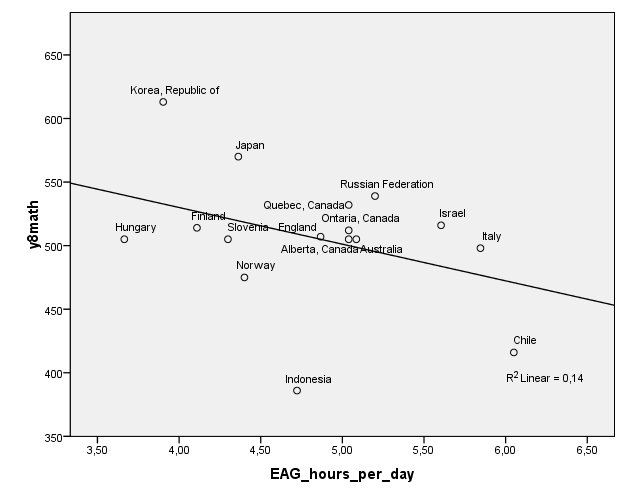
Indeed, there is a small positive correlation. This, however, can be explained by hypothesizing that some countries have short days and others have long days. To explore this hypothesis I subsequently computed the ratio of the average number of hours per year of compulsory instruction time in the curriculum for 12-14 year olds, and days of instruction for lower secondary education. Plotting these:

pisa_hours_per_daytimss_hours_per_day

This suggests there is small negative correlation between the average number of hours per day against PISA and TIMSS performance. I conclude that there is no basis for the conclusion that more school time increases performance. Actually when looking at a number of OECD indicators (and also including indicators for press freedom, the GINI index for inequality, and the Human Development Index) there only seems to be one very strong correlation for both PISA snd TIMSS (which makes sense as both are strongly correlated): a higher salary per hour of net contact (teaching) time after 15 years of experience. There is a significant positive correlation between these variables.

oecdsalaryoecdsalaryPISA

Categories
ICT Research

Convenience tooling

Saw_tooth_setter_kerfIn research we often refer to ‘convenience sampling’ as sampling where subjects are selected because of their convenient accessibility and proximity to the researcher. The most obvious criticism is sample bias. In working with other researchers, reading articles and PhD students there also is a danger of something I would like to call ‘convenience tooling’: choosing the tool first tool you see, you know or has a favorable image. Now, of course there could be many good reasons why a researcher chooses to do so. Maybe it’s because he/she has worked with or developed a certain tool. Maybe the tool in question is ‘the only tool’ that has a certain features. However, to at least have some sort of reasoning behind the tool choice, in my opinion, a good researcher should give arguments why he/she chooses a certain tool. Preferably, if the need to use a tool arises because of a certain research question or framework, a researcher should write down what features for a tool are needed to answer the research question. Then it should be argued how the chosen tool provides the features that are needed. You could compare this whole process with making a requirements document. In the end, it could very well be that the choice for a tool remains the same, but at least a researcher -just as with sampling- is ‘forced’ to make some of his/her tool choices more specific.

Categories
ICT

Following #octel

OK, so I’m not the type of person who likes to keep long personal logs or elaborate mindmaps of my thoughts. I prefer short 140 character tweets. I followed quite a few MOOCs already, finished half of them and ‘cheated’ on one because I wasn’t going to make such a concept map any way (#lak13). However, in this case I’d thought I’d make an exception. It’s for Octel, an open course in technology enhanced learning. It could easily be that this is both the first and the last post and I will continue via twitter but then it has been fun while it lasted. Will I learn new stuff? I don’t know. What I do know is that TEL has had my interest for many years now.photo-4

  1. Starting as a computer science and mathematics in 1998 I immediately started using quite a lot of technology in the classroom. With digital resources, a website, some dabblings with the first VLE’s (first versions of Moodle) and maths Java applets. First this was quite fragmented.
  2. I then started to participate in projects for techology and maths whereby we tried to design a genuine curriculum with these tools. So tools would not just be an add-on but have a place in the curriculum.
  3. In my later role as head of ICT I had to think about strategy and pedagogy: how are we going to use these tools? Can we entice teachers to use them? Why do they use them or don’t they want to use them? Although personally I think I was a frontrunner I have always thought that change should be gradual and almost develop organically. In a sense, if a lot of teachers aren’t sympathetic towards a certain change, it is OUR job to show what could be won by adopting it. And not grumble about teachers not wanting anything.
  4. In my PhD and now my work as lecturer at the University of Southampton (mathemetics education) the use and pedagogy involved with ICT tool use has a large role. I think I have some novel and explicite thoughts about this, but find that discussing these with others ‘sharpens the mind’. Thus Octel.

For me, the main question about TEL would be how to incorporate it in daily school practice, without being evangelical about it. Of course, some tools are nice and interesting to use, but do they give much in return for the investment. Wouldn’t a classroom discussion face-to-face be more efficient? When would TEL be beneficial? And would it be beneficial for everyone (social inclusion)? Not only the white upper class? How can we show teachers how you can use TEL, again, without being evangelical? And, finally, can we have the patience that is needed to integrate TEL or should we just wait and not do anything? Maybe change will come about any way, but not just tomorrow.

Categories
MathEd Research

What the research says – LKL Big Data and Learning Analytics session #wtrs8

This Thursday March 21st, I attended the eighth “What The Research Says” session at the London Knowledge Lab on Big data and Learning Analytics.

The first presentation was by Jenzabar, a service provider from Boston, USA about predictive modelling of student performance. Main objectives of the project involves academic achievement and at-risk-students. The speaker talked about some developments through the years on predictive modelling, touching upon point-in-time assessments/surveys, lagging indicators and early warnings based on observations. The second presentation was about Arbor, an adaptive system. Apparently, they sport the first NoSQL database system, using tags to capture data. Other systems can connect to their API. The third presentation by Alexandra Poulovassilis was about several tracking tools, most concerned with the Migen projecmaths-whizzt. She described the evolution of teacher tools for student progress within the system. She showed an, in my opinion, very interesting visualization of student progress, essentially a logfile. I recognized a lot of the difficulties with analyzing logfiles of student progress in my PhD. Good to see they’re working on a web-based version as well. The fourth presentation showed Maths-Whizz work. I was impressed by their dashboard and visualization. Less impressed by the actual maths content I saw in the sample. For example, why do I get 0 points if my third step in the equation in the figure?

After this I attended a more detailed session by Jenzabar. Very interesting to hear more about the Learning Analytics (or is it data mining? ;-)) process. Familiar terms like logistic regression were touched upon. It resembles some of the work I’m doing now, looking at models and seeing what recall, precision etc. are. As a system, Jenzabar looks great. Visiting their website I can read Jenzabar describes themselves as “Software, strategies, and services empowering higher ed institutions to meet administrative and academic needs.”. That explains a lot; as an educator I’m more interested in what actually happens in classrooms, rather than the admin surrounding them. Algorithms behind the system range from uni-variate models to  multivariate, naive-Bayes and regression. They aim for at least 85-95% correct predictions.

I did not have much time to look at many other systems. The discussion at the end of the session primarily touched upon privacy and ethical aspects of big data. Like other topics there seems to be quite some polarization in this discussion. on the one hand you have the people (the USA seems to be pretty easy with data) who don’t seem to see anything non-ethical about collecting data from students. The other extreme is that you would have to ask permission about anything. I don’t recall that teachers who conduct pen-and-paper tests or check homework had to ask students whether they could make a judgment based on the data collected. I think the answer (again) is in the middle: we can and should use student data (I prefer the more qualitative data) but must use it sensibly. The day finished with someone suggesting we should look into ‘teaching analytics’. I agree, that’s why we’ve put this in a European bid.

Categories
Uncategorized

xyz-MOOC reflections

There’s so much online that’s written about MOOCs. Disclaimer: I follow many MOOCs (see here) and would love to teach one. What I am getting tired of is the discussion on ‘this is too instructional’ and ‘oh, it needs to be more open’. Education has to be varied; there is room for all approaches, just as long as it fits the educational objectives and aims. Sometimes a lecture works well, so for example being told what a theory entails, and then an example, after which you try for yourself is a perfectly reasonable way to learn things. Sometimes, you can collaborate with students, in real life and online in forums. Peer review is great. We’ve got many many useful tools for teaching and learning. However, it often seems as if ‘both extremes’ of the continuum just want to make the point that ‘instruction is the devil’ or ‘problem-based learning is too vague’. Stop it!

With regard to MOOCs a recent discussion has been about success and fail factors for MOOCs. Some suggest, they even use their own fancy acronym like cMOOC or xMOOC, that some are ‘old pedagogy’ and others are ‘new’. I don’t think so. Classroom discussions, collaborations etc have been in education for centuries, so don’t pretend as if there really is something new under the sun if you look at pedagogy. Of course, there are differences in technology.

How can we explain the success of certain MOOCs, and failure of others (can we even call it a failure, in this time with more media coverage than ever?). I would like to see an analysis that takes into account factors as: difficulty level, feelings of entitlement, no obligations. Sometimes I’ve got the idea that participants feel entitled to a course that is suited for every level. So a more open ‘here are some suggestions for reading, write down what you think’ fits more of the 30k plus participants than a course with difficult maths in it. And people seem to expect that because it’s open and available it should be. I don’t agree. You can just un-enroll. So going to this case, a bit being devil’s advocate: just that thousands of students are happy with the course, doesn’t per se mean it’s a good course, just that a lot of people found it enjoyable, could cope with it, etc. Does the fact that MOOCs make courses more accessible mean that everyone’s entitled to learn? Or is this up to the learner?

Categories
Uncategorized

[Dutch treat]

cbokhove's avatarM0n0polie

In de komende week zal ik meerdere delen over onderhoud publiceren:

  1. In deel 1 zal ik vragen opwerpen over de meerjarenplanning, en laten zien dat het saldo al ruim voor eind 2016 zeer negatief wordt. Ik zal ook laten zien dat het onterecht is dat B&W stelt dat de onderhoudsplannen in gevaar komen door de ton die de oppositiepartijen niet wilden uittrekken. Immers, als dit het geval was, liepen ze om andere (college) beslissingen al meer gevaar.
  2. In deel 2 zal ik kijken naar de onderhoudsuitgaven in 2010, 2011 en de verwachte uitgaven in 2012. Ik zal laten zien dat in 2012 waarschijnlijk heel weinig is uitgegeven, veel minder dan gepland, ook volgens de onderliggende onderhoudsplannen (Cite). Nog een reden waarom de saldi (helaas) wat geflatteerd zouden kunnen zijn.
  3. In deel 3 kijk ik naar de daadwerkelijk aan het onderhoud uitgegeven bedragen, en bestudeer ik het ‘ingroeimodel’.
  4. In deel 4…

View original post 195 more words

Categories
Math Education MathEd Research

BSRML conference – report

I have written three posts on the BSRLM day conference on November 17th, 2012.

The three posts are:

BSRLM conference part 1
BSRLM conference part 2 Alnuset
BSRLM conference part 3