I have written three posts on the BSRLM day conference on November 17th, 2012.
The three posts are:
BSRLM conference part 1
BSRLM conference part 2 Alnuset
BSRLM conference part 3
I have written three posts on the BSRLM day conference on November 17th, 2012.
The three posts are:
BSRLM conference part 1
BSRLM conference part 2 Alnuset
BSRLM conference part 3
The fourth session by Ainley reported on the Fibonacci project, integrating inquiry in mathematics and science education. It was good to hear that the word ‘utility’ that was used, did not refer to a utilitarian view of maths, i.c. that everything should have a clear purpose. I mention this as discussions about utility often tend to end in comments like ‘what’s the point of doing algebra’? Actually, I think that does have a purpose, amongst others ‘analytical thinking’ but I prefer steering clear from these types of pointless discussions. The best slide, I though, was a slide with science, statistics and mathematics in the columns and rows with a distinction in, for example, their purpose.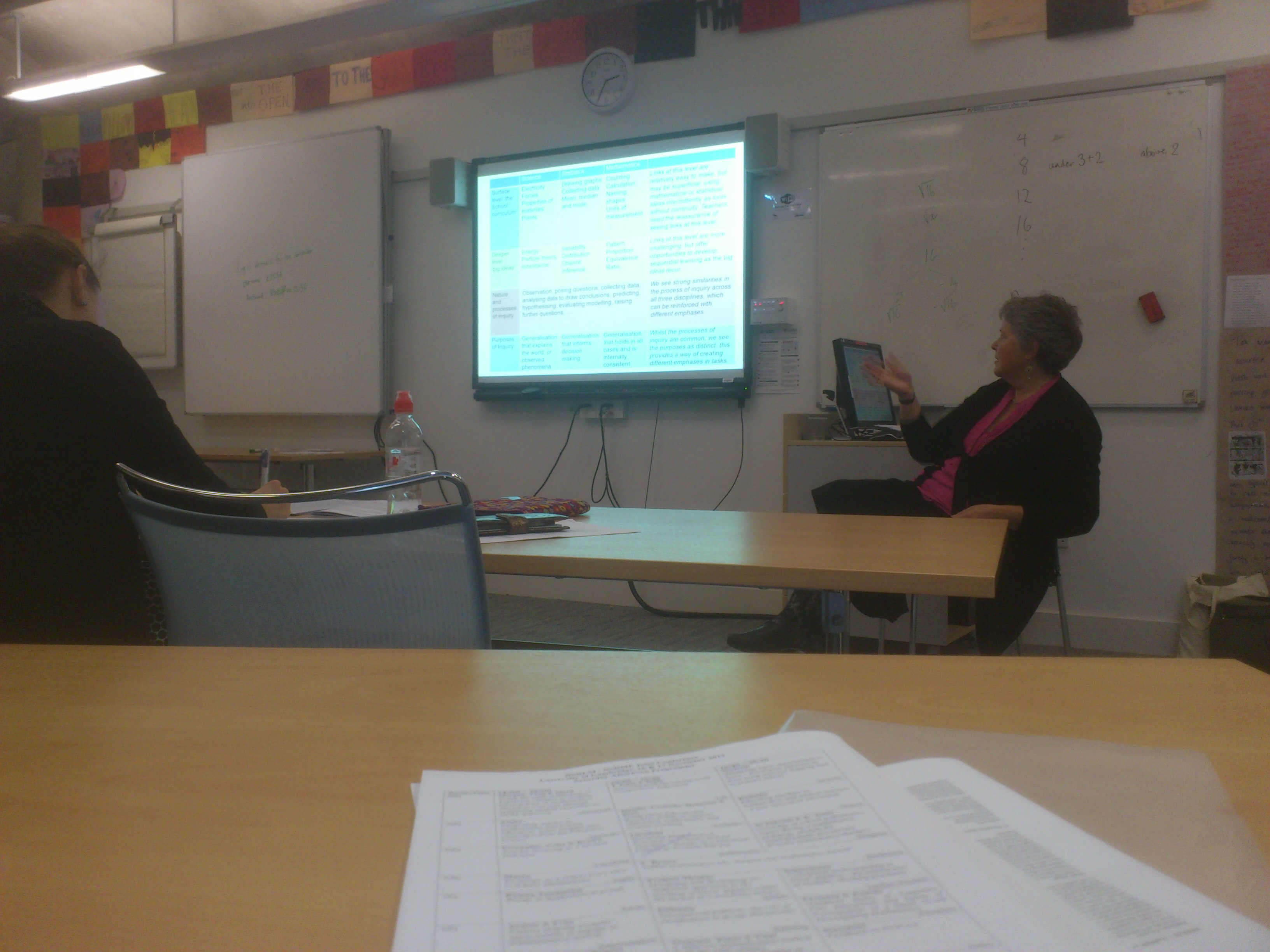
It formed a coherent picture of STEM. The two examples for integrative projects were ‘building a zoo’ which I didn’t like when it concerned the context of fences that had to be built. It’s the lack of creativity that often is in textbooks as well. the second project, on gliders, was more interesting but the mathematical component seemed to belong more in statistics used. I would loved to have seen a good mathematical example.
The fifth session by Hassler and Blair was about Open Educational Resources. The project, funded by JISC, acknowledged three freedoms: legal, technical and educational. It is a project that boasted a website with educational resources, free to use, keywords and with pdf creator. Although nicely implemented, to me, it seemed to be a bit ‘yet another portal’. The individual elements weren’t that novel either, with for example a book creator also in the Activemath project. The most interesting thing was the fact that the materials were aimed at ‘interactive teaching’.
The sixth and last session was a presentation by Kislenko from Estiona. She described how in Estonia a new curriculum was implemented for educating teachers in mathematics and natural sciences. It was an interesting story, although I was wondering how ‘new’ it was, as the title had the term ‘innovative’ in it.
Together with some networking these sessions made up an interesting and useful day in Cambridge.
The third session I attended was more a discussion and critique session, led by Monaghan and Mason, on the topic of ‘cultural affordances’. The basis was the work of Chiappini, who -in the ReMath project- used the software program Alnuset (see here to download it) to look at (its) affordances. Monaghan described the work (a paper on the topic, there will be a publication in 2013, was available) and then asked some questions. Chiappini distinguishes three layers of affordances: perceived, ergonomic and cultural. Engestroms cycle of expansive learning is used, as I understood it, to use activities as drivers for transformation of ergonomic affordances into cultural affordances. Monaghan then asked some critical questions, under which whether the theory of Engestrom really was necessary, wouldn’t for example Radfords work on gestures be more appropriate? Another comment pondered whether the steps for expansive learning were prescriptive or descriptive. I think the former: as the author has made the software with certain design elements in mind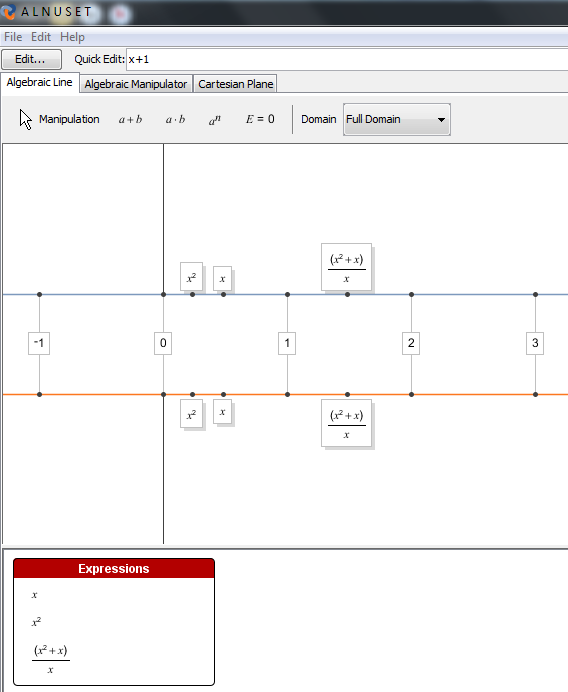 it is pretty obvious that they have a preconceived notion of how student learning should take place. It was pretty hard to discuss these more philosophical issues in detail. I’m not really sure if I even understand the work. Although this could be solely because I haven’t read enough about it, I also feel a bit as if ‘difficult words’ are used to state the obvious. I could only describe what I was thinking off. The article that I took home afterwards gave some more pointers. To get a grasp of this I downloaded the software, that reminded me a bit of the Freudenthal Institute’s ‘Geometrische algebra’ applets, and tried out the software. I liked the idea behind the software. In this example I’ve made three expressions, and I can manipulate x. The other two expressions change with x. Some comments:
On Saturday November 17th I visited the second day of the BSRLM conference (British Society for Research into Learning Mathematics). I’ve become a member as it’s ‘the place to be’ for maths education research. This time the conference was in Cambridge, and apparently I was the only one tweeting #bsrlm.
The first session I attended was by Anne Berit Fuglestadt from the university of Agder (soon, homebase of a Dutch researcher I know). She reported about teachers discussing inquiry-based teaching with digital tools.
The second half of the session consisted of discussions on instrumental and documentational genesis (The French School, Trouche is an important name). This was fitting, as one PhD student I (co-)supervise is studying instrumentation as underpinning framework for her study.
The second session was an interesting take on use of the Livescribe pen. At first it seemed as if the study, done by Hickman and Monaghan, seemed a bit of a waste of the livescribe pen. Emphasis was put on the audio recording facilities.
Luckily, as I could have expected, they did more with the pen. The pens were used to record student work while ‘thinking aloud’ and these materials (a sort of screencasts of what was written) were used for a combination of stimulated recall and task-based interviews (e.g. Goldin, 1997). Hickman showed some discourse by primary students that was recorded with the pen. It was nice to see student work being ‘constructed’ instead of just having static scans of their work. It also was nice that we could try out the pen ourselves. I did think more can be done with even the older generation of pens. For example, Dragon Naturally Speaking does doe a decent job of transcribing voice, just as long as it is trained to recognize it. It will certainly cut the amount of time you need for transcribing an hours worth of audio.
Another application to use would be Myscript, from the same company that brings a great online equation recognizer. The latest version of the pen also boasts Wifi and Evernote integration, so it looks interesting. It will certainly be worthwhile to check out this for our SKE+ group. A follow-up discussion could be whether these devices will eventually become obsolete if tablet technology with styli, like the Galaxy Note, takes off.
 Christian Bokhove