Categories
ICT Math Education MathEd Tools

Dabbling in Sketchometry

Sketchometry

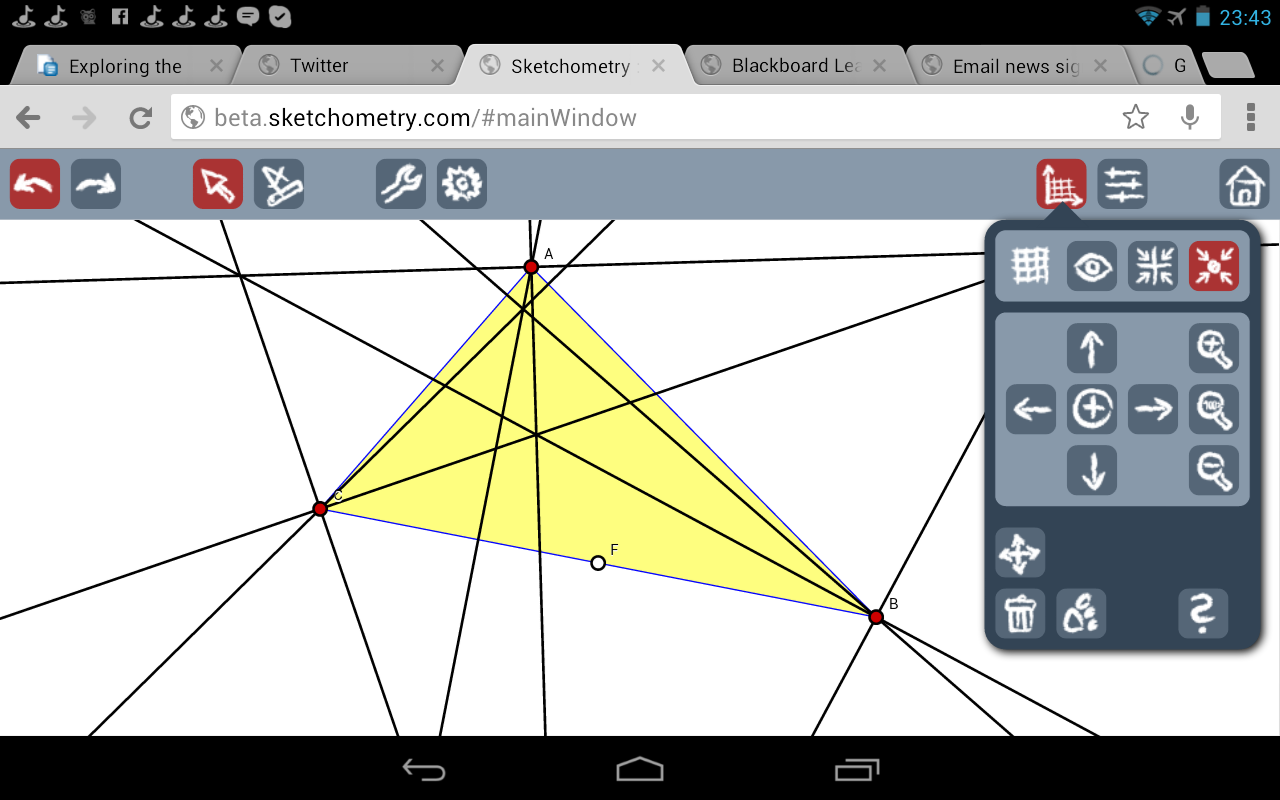
After being alerted by a colleague, today I dabbled a bit in Sketchometry. I like it. It can recognize finger gestures, especially useful on tablets, for geometric constructions. There is a calculus function but frankly, this adds nothing to the program. Its strength lies in geometry, and the fact that it works on almost everything, as it is web-based. Furthermore it connects to Dropbox and other cloud-systems. It took a while to get used to the cluttered user interface. Reading this file with available gestures really helped a lot (although there is a mistake, where naturally making a circle should give a circle not a straight line). The number of options and features is not very large.

Midpoint gesture

The quintessential construction is the Euler line. I tried to make this on a Nexus. The screen isn’t big enough, really, for the best experience. Also, the use of my (fat) fingers did not work all that well. Certain gestures were hard to carry out, especially if they involved selecting certain points, like drawing perpendiculars or designating intersections. But even if this was the case, it was great to be able to use gestures, anyway. After around 200 gestures (I had to undo many of them because it recognized the wrong ones) I had something that resembled Euler’s line. I loved the gestures for bisectors and midpoints, with the latter being a one from point to point and a loop in the middle. With quite a few objects the application did seem to slow down considerably, and some icons seemed to disappear.

This could be the case because it could be considered a beta version. What bodes less well for the future is the fact that the most recent post is from Jun 23rd (2012). I hope this does not mean it is the end-product of ‘yet another project’, and now that the project is finished no more updates are given. One of the strengths of for example Geogebra is that it managed to create a large userbase and community working on the software, but also creating content.

Of course, the application would have been even better if it would provide character and formula recognition like in windows 7, Snote by samsung, Inftyreader or visionobjects….. 🙂 But overall it is a great concept!

Dabbling in Sketchometry
Categories
Math Education Math trivia MathEd

To the 0th power

On twitter I got involved in a discussion on exponents. At first it started with square roots being the same as ‘to the power of 0.5’. The first tweet commented on a blog that stated suprise about the fact that students did not know why the square root of a number was equivalent to ‘to the 0.5th power’. Of course this can be readily proved by using the definition of sum of exponents. I certainly agree with the fact that a lot of students (and teachers?) don’t know why some rules apply. But to me, this is closely related to all the rules that we use. So later on the discussion became more general, and was about when you assume certain properties and when you don’t assume them. For example. proving g^0=1 can be done by using the rule for exponents g^a/g^b=g^{a-b} and so if a=b then g^0=1. But you could also say that, just like g^a/g^b=g^{a-b}g^0=1 could be assumed when proven. If you would state: ‘but I want g^0=1 to be proven from the most basic rules and assumptions’ this seems a fair request.

However, then I would say it is not necessary to assume the rule g^a/g^b=g^{a-b} but that {g^a} \cdot {g^b} = g^{a+b} is enough. Because let a=0 then {g^0} \cdot {g^b} which is (under this law) g^{0+b}=g^b . So {g^0} \cdot {g^b}= g^b and so g^0 must be 1.

Proofwiki has an excellent list of the (inter-)dependency of exponent laws. I know it perhaps is nitpicking if I say ‘assuming less is better’ but some of the rules and laws we commonly use are not always that trivial. For students this is a nice way to approach it. It even has a link to a great question by a student whether we have to define or prove g^0=1. Actually I don’t really care whether you prove it or not, but I do think some ‘feel’ for assumptions, axioms, dependencies etc. is useful for everyone. This was the only point I was trying to make.

A special case involves 0^0 which is indeterminate.

@sndrclsn (who also made this nice picture) tweeted about his great movie bij James Tanton on “zero to the zero”-th power.


It sparked many more musing, like plotting x^y in Wolfram and in Google. But there are other views, like this one stating that 0^0=1 and also the Math Forum has some interesting quotes.

Categories
ICT Math Education MathEd Tools

Teaching kids real math with computers: a comment on Wolfram

Only recently I read this blogpost on a TED talk by Conrad Wolfram.


Although I agree with most in the blogpost, I think Wolfram paints a caricature of mathematics.  Let me make some comments.

I think Wolfram generalizes too much with regard to different countries. I don’t really know that much about the US situation, but I have the impression that procedural fluency and computation are valued much more over there than in Asia or Europe. Something that Michael Pershan also points out in this excellent video. In the Netherlands conceptual understanding is deemed more important, as is the connection to the real world. In this respect Wolfram exaggerates the percentage involved in computation (80% computation by hand).

This brings me to another point. Wolfram is highly involved with some of the developments of Mathematica software (which his brother Stephen created). He even shows it off in his talk. Undoubtedly, Mathematica and Wolfram Alpha are great pieces of software, that can perform awesome calculations. This, however, makes clear that that using a tool to get rid of computation is what is central in his talk, not the other three points.

Mind you, these three steps are very important, and remind me of Polya on problem solving. I just don’t agree with Wolframs fixation on discarding the third point. Wolfram does see a place for teaching ‘computation’ and says we “only [should] do hand calculations where it makes sense”. He also talks about what ‘the basics’ are, and makes a comparison with technology and engineering in cars. Here it would have helped if Wolfram would have acknowledged the difference between blackbox/whitebox systems (see Buchberger, http://dl.acm.org/citation.cfm?id=1095228):

In the “white box” phase, algorithms must be studied thoroughly, i.e. the underlying theory must be treated completely and algorithmic examples must be studied in all details. In the black box phase, problem instances from the area can be solved by using symbolic computation software systems. This principle can be applied recursively.

The whole section where Wolfram addresses criticims of his approach sounds far too defensive. He does not agree with the fact that mathematics is dumbed down, and using computers is just ‘pushing the buttons’. This has to do with the traditional discussion between ‘Use to learn’ and ‘Learn to use’. Again, I think Wolframs whole argumentation is a bit shaky: first he attacks learning algorithms with pen-and-paper , but then he does see a fantastic use regarding understanding processes and procedures. This is where Wolfram applauds programming as a subject. Then he shows many applications with sliders and claims: Feel the math! He shows an application for increasing the sides of a polygon and claims this introduces  the “early step into limits”. By using a slider? I’m thinking of an applet I used in my math class teaching the concept of slopes and differentation. I thought it worked pretty well…until I found out students were just dragging the two points together. So what is actually learned?

As another example, there is a part where Wolfram subtitutes the power 2 with a 4, uses Mathematica, and then says ‘same principles are applied’.
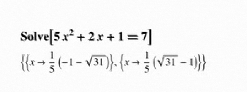
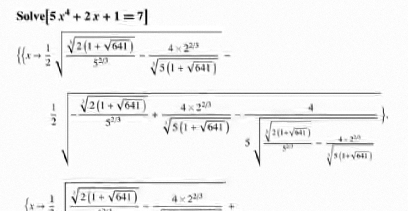
If he means that the same piece of software was used, then this is the same principle. If his claim is that the mathematics behind solving an higher order equation uses the same principles as solving a quadratic equation, then I wonder if this really is the message you want to convey to students. Of course the outside world has much more difficult equations, and that brings me to a final point made, concerning a ‘means to an end’. Wolfram does not define what the actual goal of mathematics is. If it is ‘getting the result’ then one could argue that using a computer over doing it by hand makes sense. However, if -and that was Wolframs claim- the goal is ‘teaching’ then I think mathematics brings more than just some results. Wolfram seems to see mathematics as a supporting science for other subjects, and does not seem to acknowledge a broader view of mathematics as a subject aimed at problem. Which is strange regarding Wolframs initial words on really teaching mathematics.

By no means I’m claiming this is an overly extensive critique of Wolfram’s talk, just a few points that -to me- warrant the conclusion that Wolfram paints too much of a caricature of maths education. I’d rather keep it with the conclusion of the blogpost it started with (translation): “Put aside those textbook with tasks, en tell students what has inspired you to learn your subject. Tell stories. Or get people into the classroom to show inspring examples. Let students look at problems in a different way, and see how they can address these problems with the help of mathematics.”. Amen.

Categories
ICT Math Education MathEd Tools

Storing student work and checking geometry tasks

One of the –in my opinion- most impressive features I have seen in mathematics software is the recent fusion of the Freudenthal Institutes (FI) DME (Digital Mathematical Environment), good content and the ability to plug in components like Geogebra. Of course, it also is software that I know well, because my thesis (www.algebrametinzicht.nl) also used the DME.

For the DPICT project of the FI several lesson series were also translated to English. One of them concerned Geometry. Articles and papers of the project will appear, but I think the material warrants an impression in screenshots.

Logging in as a student:

Accessing the Geometry module:

The geometry module consists of several activities:

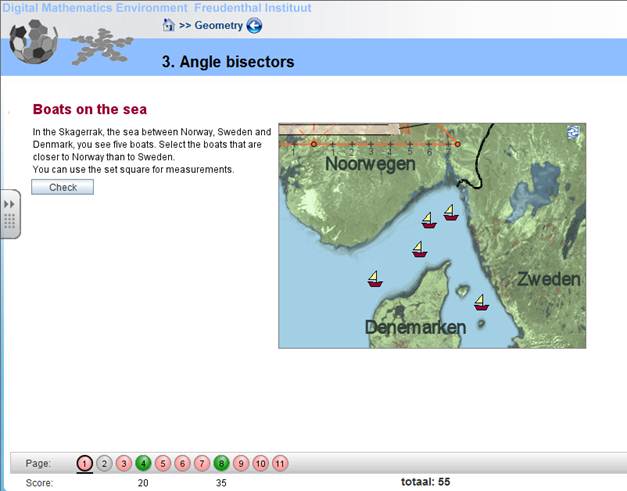
One of the activities starts with a task not uncommon in Dutch textbooks:

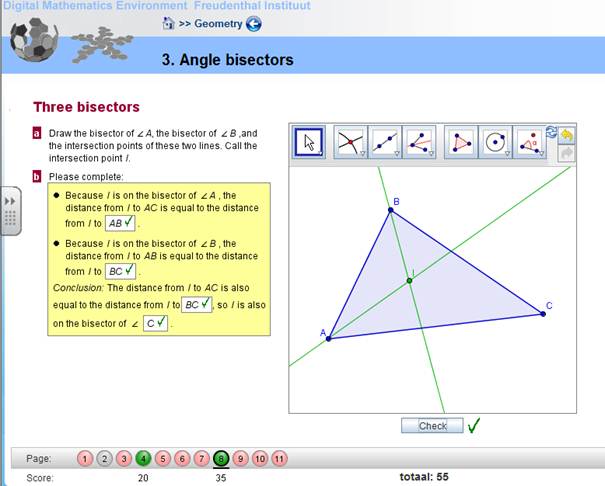
Geometric construction on the right side can be checked. There are open textboxes (which can’t be checked on correct or incorrect, but can be accessed by the teacher). Note that the [c] task, a drop and drag task, was answered incorrectly.

After correcting:

Another task where both constructions and answers are checked:

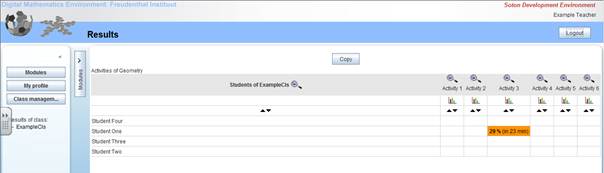
Teachers can see how students performed:

Teacher looks at the task shown earlier:

Categories
Uncategorized

A short report on ICME-12

On July 7th I spent the last part of the bonus I got for finishing my Dudoc PhD within time: I was able to go to ICME-12. I went there to present my paper (co-authored by Paul Drijvers, as he’s supervised me well, making me an independent researcher) on the effects on a digital intervention on algebraic expertise. This topic also was the title of my thesis. ICME-12 took place in Seoul, South-Korea, a large and bustling city. Compared to the scale of the Netherlands, everything was pretty large. The population, inner Seoul almost 10 mln,greater Seoul almost 30 mln. The size of the buildings. The amount of coffeeshops is staggering. This post only gives a short and incomplete impression of the conference.

To avoid a jetlag the first day was spent visiting a local market and walking the large hill in the centre of Seoul. After this I registered for the conference. The first real conference day started off with the opening ceremony and a first plenary. The first plenary was, of course, a local affair on “Mathematics Education in the National Curriculum System” by Don Hee Lee. It gave an impression of maths education in Asia. It started off a series of plenaries throughout the week. One of the plenaries that stood out for me was that of Etienne Ghys. The rewarding topic was well known, but what I especially loved was the ease of presentation. Standing there relaxed, walking around, slides timed to perfection (and also translated to Korean), and great animations. This is what a good presentation should be. I am curious if less known, and perhaps boring topics, could also be given this royal treatment. It was a shame the plenary by Jo Boaler was cancelled because of illness. Although I’m sure one of her student did a good job in reciting Boalers’s work, I prefer real presentations. I opted to go to a different Regular Lecture.

Throughout the conference I attended Topic Study Group 19 (TSG19) on analysis of uses of technology in the learning of mathematics, chaired by Weigand and Borba. I must say that I knew about most topics already. Some examples of nice project results, to me, were the Virtual Math Teams, now with Geogebra integration. Also, a mobile app -resembling geocaching principles I should add- with maths assignments, stood out. It was especially nice that they had added four assignments within the COEX venue in Seoul where the conference took place. I also was able to present my work (slideshare). However, most papers were summarized by team members from TSG19.

I also attended a Workshop session and a Discussion group. The first was about “How Representation and Communication Infrastructures can enhance mathematics teacher training” and yielded recommendations for teacher training. The latter was about “New Challenges in Developing Dynamic Software for Teaching and Learning Mathematics” and consisted of many short presentations on tools, authoring and assessment. To me, the most interesting discussion was at the end of the second session. Although designers of Sketchpad and Cabri painted a bit of a caricature of open source software, stating that it was only chosen because it was free, these comments did spark a dialogue about the costs of designing good software. I wish there would have been a bit more time to work this out.

The final plenary was given bij Werner Blum, whom I know from the modelling cycle he did with Leiss. This cycle actually had a prominent place in a recent review I did of a thesis. This talk was titled “Quality Teaching of Mathematical Modelling – What Do We Know, What Can We Do?” and described the most important criteria and showed some examples (at the secondary level) of how teachers have successfully implemented criteria for modelling in their classrooms. The last Regular Lecture I attended was by Ilana Horn who talked about “Teachers Learning Together: Pedagogical Reasoning in Mathematics Teachers’ Collaborative Conversations“. I still have to see whether I can use some of these ideas for pre-service teacher training.

The ICME-12 closing ceremony boasted the seriously impressive Korean dancegroup Noreum Machi. In 2016 ICME-13 will be in Europe, Hamburg. Looking forward to another interesting encounter with research on mathematics education.

Categories
ICT Math Education MathEd Tools

Rapid Miner datamining

I recently got into a discussion about datamining. I actually think we have just started to scratch the surface of big data, Learning Analytics and Educational Datamining. As, for example, the Digitale Mathematical Environment (DME, see here), can produce large logfiles of all students’ actions it would be interesting to see if we can find patterns with machine learning techniques. One thing I would like to find out is whether a collaboration with a Computer Science department is possible. I was just dabbling in Rapid Miner, which works and looks great. Using Paren, Automatic System Construction, I trained a sample set of information on Irises. For the future I will see if I can use Rapid Miner. Another option is Weka.

Categories
Math Education MathEd Tools

Algebrakit-toets

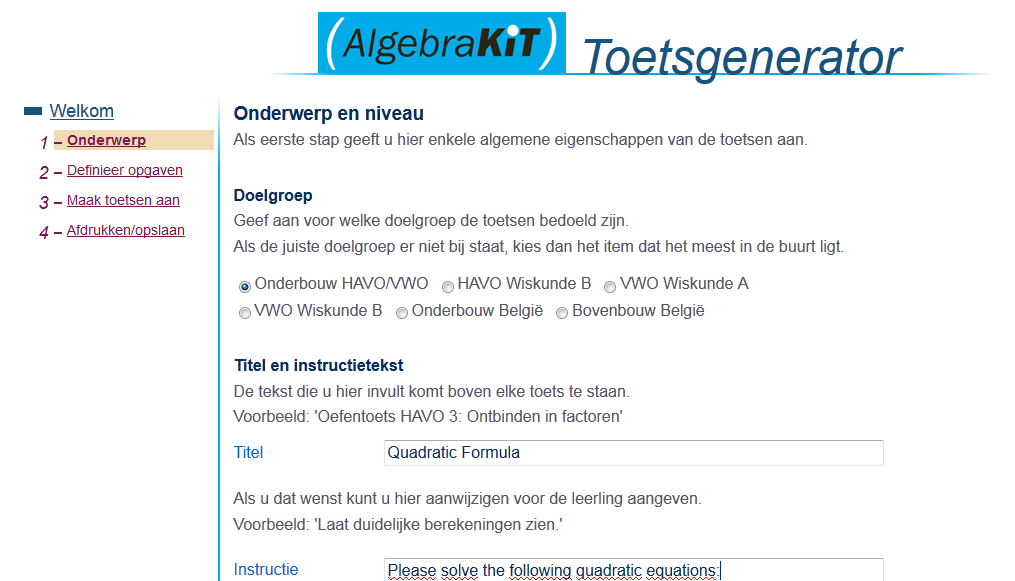
A while back I stumbled on Algebrakit-toets. I never got round to archiving and/or describing it, so here gooes. Algebrakit-toets provides an semi-automatic environment for creating tests and answer-sheets. It can be started here (Dutch, programmer Martijn Slob).

In a wizard-like environment it can:

  • Make tasks for various levels and years.
  • Every student gets a differently randomized test.
  • Every test can be accompanied by an answer sheet

Step 1: general information: first input general information on the test

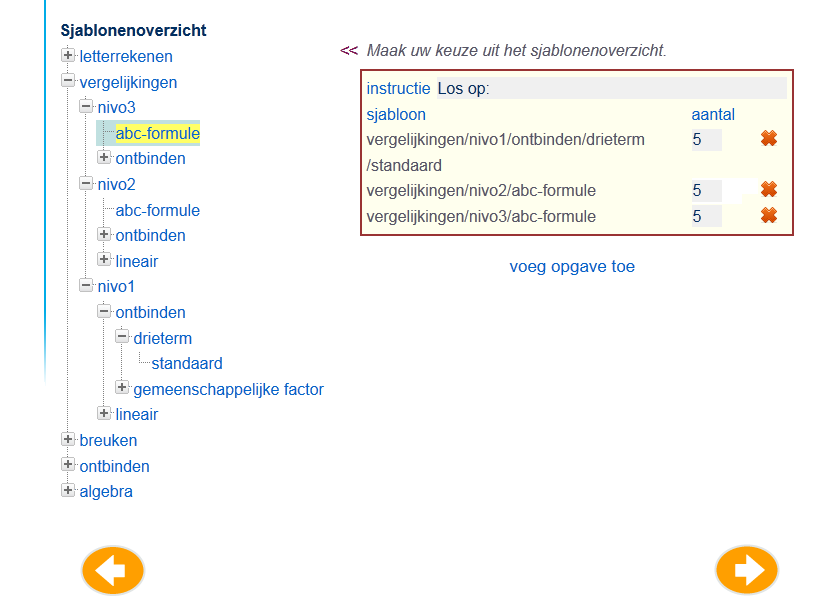
Step 2: choose the level, subject and number of tasks. Note that changing the order of questions seems a bit hard to do.

Step 3: now indicate how many different tests you need

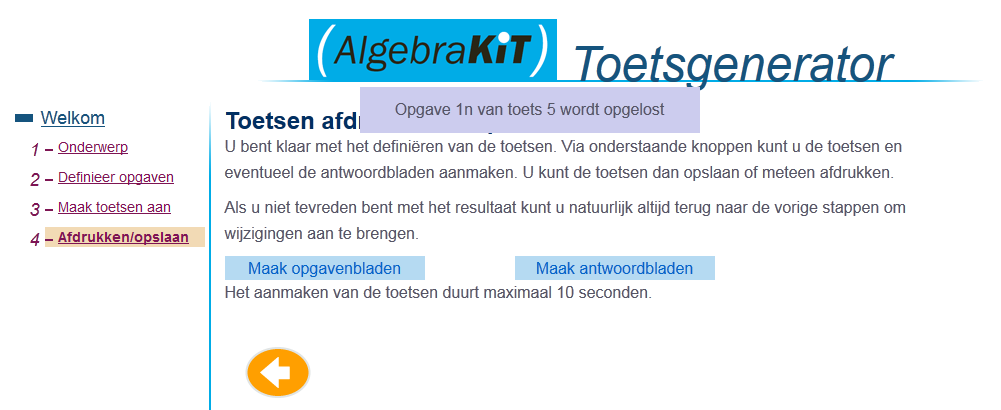
Step 4: clicking “Genereer toetsen” makes the appropriate tests. Clicking “Bereken de antwoorden” generates the answers. This can take a while. Clicking the button shows intermediate steps. You can also choose just to continue.

Step 5: here, finally you can download the task and answer sheets. Nte: for the latter to work you will have to “Bereken de antwoorden”.

Click AlgebraKIT-toets for an example task sheets.
Click AlgebraKIT-toets-antw for the accompanying answer sheets.

Categories
Entertainment Music

Good Old War – After the Party

Categories
Math trivia

Elfenland and Graph Theory

Quite a while back I supervised a class project on graph theory. One inspiration was the boardgame Elfenland. Back then I made quite an elaborate series of lessons involving graph theory and that game. I remembered this because of a tweet involving this post on math strategies for games. Unfortunately I couldn’t find all the documents. On a more modest basis I have recreated some of the activities.

Elfenland is a game that involves using cards to travel from one point to the other. The board is below.

The first step is to transform this board to a graph. There are some difficulties and/or assumption:

  • If one can travel from A to B I have added a vertices and an edge.
  • I did not model any weights or “one way” edges (like 17 to 16, 16 to 15, for labels see below).

I then inputted the graph in Graph Magic (http://www.graph-magics.com/).

Now, assuming that one has to start and end in the capital at vertex 17, It is clear that because of vertex 7, a Hamiltonian circuit cannot be found, as vertex 9 is passed at least twice. So, I excluded vertex 7. Calculating the circuit for the remainder of the graph would suffice, just as long as the player would visit vertex 7 when arriving in vertex 9. The result was:

In this optimal route edges between 17,16 and 15 are not used so the problem of “one way” edges does not have a direct consequence for my strategy. In the next steps weights were added according to the Elfenland rules. In the real game, chance plays a role as travel is done by using playing cards. I have no time to improve it in this occasion, I’ll leave that to you. I think it is a nice introduction to some Graph Theory concepts.

Categories
ICT MathEd

Khan Academy

On the MathEd mailing list I’m on there was some inquiry on Khan Academy. I gave my short description/opinion:

Khan Academy (KA) is often associated with a “pedagogy” denoted as “Flipping the classroom”, which denotes that instruction shifts towards “outside the classroom” through the use of videos, freeing up time for useful classroom discussions, making exercises ín the classroom. Personally I don’t see the novelty in that, as many (good) teachers already use many ways to motivate students. However, at least in de US people seem to take up the movies especially in a homeschooling setting, so perhaps this engagement could be seen as a positive thing. It also depends on the math ed culture in a country.

The movies vary greatly in quality, both mathematically as esthetically. Khan himself has said that the “ugly” movies often were most succesful. Recently -also see documentary 60 minutes- there have been some indications that the movies aren’t watched that well. To improve the content KA has joined up with people like Vi Hart (see http://vihart.com/blog/announcement-khan-academy/) whom we know of the great Pi & Shakespeare movie. As mentioned before, Bill Gates, has taken on Khan as his protege. providing him with ample funds. Because of this backing I think KA probably will have more of a chance to survive the hausse in digital mathematics tools.

A second part of the academy is the exercise section. Good learning analytics, and a great visual map for presenting dependencies and progress in a curriculum. Still, this is the part I am underwhelmed with. A bit too “drill and practice” to my taste. Only answers. This interactive part should, imo., be improved much more.

So, as with many things, a critical view is necessary, but not without acknowledging the positive things.