Categories
ICT Math Education MathEd Tools

Teaching kids real math with computers: a comment on Wolfram

Only recently I read this blogpost on a TED talk by Conrad Wolfram.


Although I agree with most in the blogpost, I think Wolfram paints a caricature of mathematics.  Let me make some comments.

I think Wolfram generalizes too much with regard to different countries. I don’t really know that much about the US situation, but I have the impression that procedural fluency and computation are valued much more over there than in Asia or Europe. Something that Michael Pershan also points out in this excellent video. In the Netherlands conceptual understanding is deemed more important, as is the connection to the real world. In this respect Wolfram exaggerates the percentage involved in computation (80% computation by hand).

This brings me to another point. Wolfram is highly involved with some of the developments of Mathematica software (which his brother Stephen created). He even shows it off in his talk. Undoubtedly, Mathematica and Wolfram Alpha are great pieces of software, that can perform awesome calculations. This, however, makes clear that that using a tool to get rid of computation is what is central in his talk, not the other three points.

Mind you, these three steps are very important, and remind me of Polya on problem solving. I just don’t agree with Wolframs fixation on discarding the third point. Wolfram does see a place for teaching ‘computation’ and says we “only [should] do hand calculations where it makes sense”. He also talks about what ‘the basics’ are, and makes a comparison with technology and engineering in cars. Here it would have helped if Wolfram would have acknowledged the difference between blackbox/whitebox systems (see Buchberger, http://dl.acm.org/citation.cfm?id=1095228):

In the “white box” phase, algorithms must be studied thoroughly, i.e. the underlying theory must be treated completely and algorithmic examples must be studied in all details. In the black box phase, problem instances from the area can be solved by using symbolic computation software systems. This principle can be applied recursively.

The whole section where Wolfram addresses criticims of his approach sounds far too defensive. He does not agree with the fact that mathematics is dumbed down, and using computers is just ‘pushing the buttons’. This has to do with the traditional discussion between ‘Use to learn’ and ‘Learn to use’. Again, I think Wolframs whole argumentation is a bit shaky: first he attacks learning algorithms with pen-and-paper , but then he does see a fantastic use regarding understanding processes and procedures. This is where Wolfram applauds programming as a subject. Then he shows many applications with sliders and claims: Feel the math! He shows an application for increasing the sides of a polygon and claims this introduces  the “early step into limits”. By using a slider? I’m thinking of an applet I used in my math class teaching the concept of slopes and differentation. I thought it worked pretty well…until I found out students were just dragging the two points together. So what is actually learned?

As another example, there is a part where Wolfram subtitutes the power 2 with a 4, uses Mathematica, and then says ‘same principles are applied’.

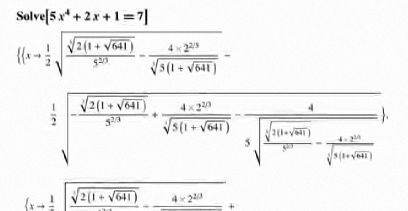
If he means that the same piece of software was used, then this is the same principle. If his claim is that the mathematics behind solving an higher order equation uses the same principles as solving a quadratic equation, then I wonder if this really is the message you want to convey to students. Of course the outside world has much more difficult equations, and that brings me to a final point made, concerning a ‘means to an end’. Wolfram does not define what the actual goal of mathematics is. If it is ‘getting the result’ then one could argue that using a computer over doing it by hand makes sense. However, if -and that was Wolframs claim- the goal is ‘teaching’ then I think mathematics brings more than just some results. Wolfram seems to see mathematics as a supporting science for other subjects, and does not seem to acknowledge a broader view of mathematics as a subject aimed at problem. Which is strange regarding Wolframs initial words on really teaching mathematics.

By no means I’m claiming this is an overly extensive critique of Wolfram’s talk, just a few points that -to me- warrant the conclusion that Wolfram paints too much of a caricature of maths education. I’d rather keep it with the conclusion of the blogpost it started with (translation): “Put aside those textbook with tasks, en tell students what has inspired you to learn your subject. Tell stories. Or get people into the classroom to show inspring examples. Let students look at problems in a different way, and see how they can address these problems with the help of mathematics.”. Amen.


Categories
ICT Math Education MathEd Tools

Storing student work and checking geometry tasks

One of the –in my opinion- most impressive features I have seen in mathematics software is the recent fusion of the Freudenthal Institutes (FI) DME (Digital Mathematical Environment), good content and the ability to plug in components like Geogebra. Of course, it also is software that I know well, because my thesis (www.algebrametinzicht.nl) also used the DME.

For the DPICT project of the FI several lesson series were also translated to English. One of them concerned Geometry. Articles and papers of the project will appear, but I think the material warrants an impression in screenshots.

Logging in as a student:

Accessing the Geometry module:

The geometry module consists of several activities:

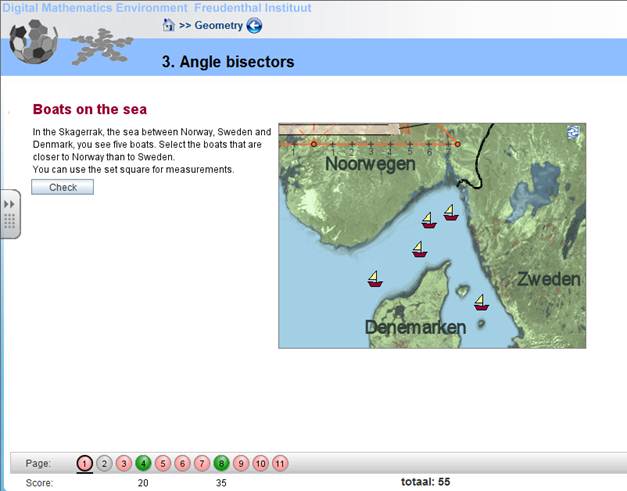
One of the activities starts with a task not uncommon in Dutch textbooks:

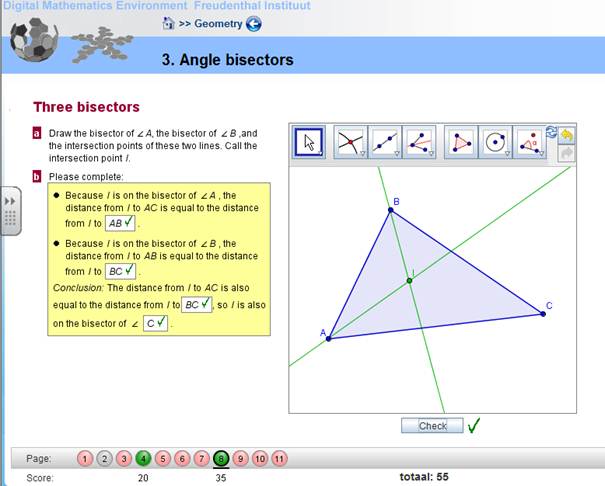
Geometric construction on the right side can be checked. There are open textboxes (which can’t be checked on correct or incorrect, but can be accessed by the teacher). Note that the [c] task, a drop and drag task, was answered incorrectly.

After correcting:

Another task where both constructions and answers are checked:

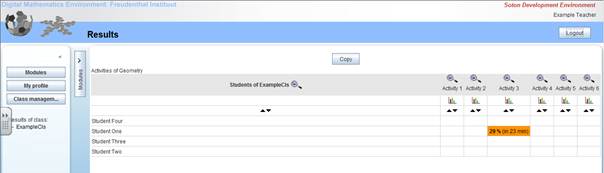
Teachers can see how students performed:

Teacher looks at the task shown earlier:

Categories
Uncategorized

A short report on ICME-12

On July 7th I spent the last part of the bonus I got for finishing my Dudoc PhD within time: I was able to go to ICME-12. I went there to present my paper (co-authored by Paul Drijvers, as he’s supervised me well, making me an independent researcher) on the effects on a digital intervention on algebraic expertise. This topic also was the title of my thesis. ICME-12 took place in Seoul, South-Korea, a large and bustling city. Compared to the scale of the Netherlands, everything was pretty large. The population, inner Seoul almost 10 mln,greater Seoul almost 30 mln. The size of the buildings. The amount of coffeeshops is staggering. This post only gives a short and incomplete impression of the conference.

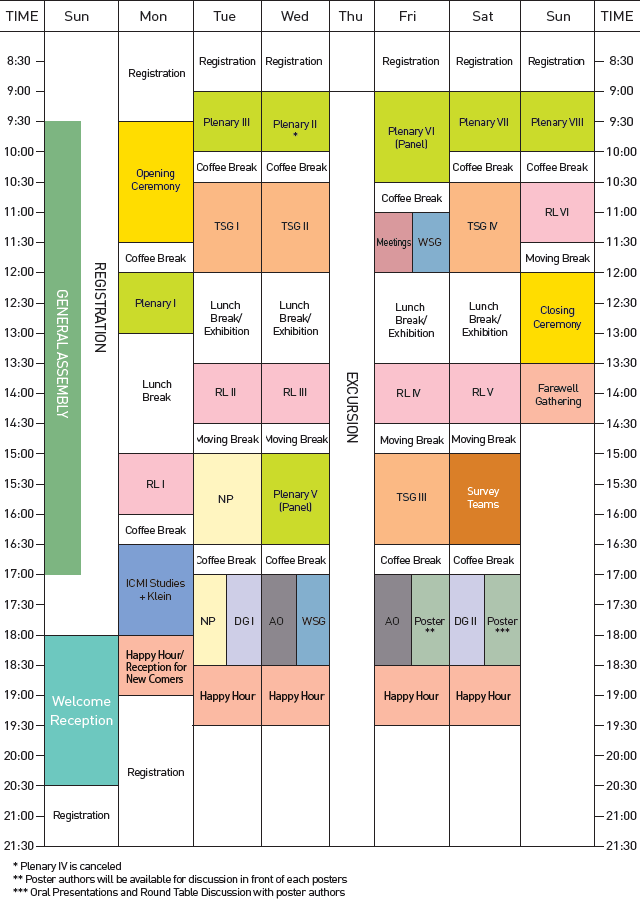
To avoid a jetlag the first day was spent visiting a local market and walking the large hill in the centre of Seoul. After this I registered for the conference. The first real conference day started off with the opening ceremony and a first plenary. The first plenary was, of course, a local affair on “Mathematics Education in the National Curriculum System” by Don Hee Lee. It gave an impression of maths education in Asia. It started off a series of plenaries throughout the week. One of the plenaries that stood out for me was that of Etienne Ghys. The rewarding topic was well known, but what I especially loved was the ease of presentation. Standing there relaxed, walking around, slides timed to perfection (and also translated to Korean), and great animations. This is what a good presentation should be. I am curious if less known, and perhaps boring topics, could also be given this royal treatment. It was a shame the plenary by Jo Boaler was cancelled because of illness. Although I’m sure one of her student did a good job in reciting Boalers’s work, I prefer real presentations. I opted to go to a different Regular Lecture.

Throughout the conference I attended Topic Study Group 19 (TSG19) on analysis of uses of technology in the learning of mathematics, chaired by Weigand and Borba. I must say that I knew about most topics already. Some examples of nice project results, to me, were the Virtual Math Teams, now with Geogebra integration. Also, a mobile app -resembling geocaching principles I should add- with maths assignments, stood out. It was especially nice that they had added four assignments within the COEX venue in Seoul where the conference took place. I also was able to present my work (slideshare). However, most papers were summarized by team members from TSG19.

I also attended a Workshop session and a Discussion group. The first was about “How Representation and Communication Infrastructures can enhance mathematics teacher training” and yielded recommendations for teacher training. The latter was about “New Challenges in Developing Dynamic Software for Teaching and Learning Mathematics” and consisted of many short presentations on tools, authoring and assessment. To me, the most interesting discussion was at the end of the second session. Although designers of Sketchpad and Cabri painted a bit of a caricature of open source software, stating that it was only chosen because it was free, these comments did spark a dialogue about the costs of designing good software. I wish there would have been a bit more time to work this out.

The final plenary was given bij Werner Blum, whom I know from the modelling cycle he did with Leiss. This cycle actually had a prominent place in a recent review I did of a thesis. This talk was titled “Quality Teaching of Mathematical Modelling – What Do We Know, What Can We Do?” and described the most important criteria and showed some examples (at the secondary level) of how teachers have successfully implemented criteria for modelling in their classrooms. The last Regular Lecture I attended was by Ilana Horn who talked about “Teachers Learning Together: Pedagogical Reasoning in Mathematics Teachers’ Collaborative Conversations“. I still have to see whether I can use some of these ideas for pre-service teacher training.

The ICME-12 closing ceremony boasted the seriously impressive Korean dancegroup Noreum Machi. In 2016 ICME-13 will be in Europe, Hamburg. Looking forward to another interesting encounter with research on mathematics education.

Categories
ICT Math Education MathEd Tools

Rapid Miner datamining

I recently got into a discussion about datamining. I actually think we have just started to scratch the surface of big data, Learning Analytics and Educational Datamining. As, for example, the Digitale Mathematical Environment (DME, see here), can produce large logfiles of all students’ actions it would be interesting to see if we can find patterns with machine learning techniques. One thing I would like to find out is whether a collaboration with a Computer Science department is possible. I was just dabbling in Rapid Miner, which works and looks great. Using Paren, Automatic System Construction, I trained a sample set of information on Irises. For the future I will see if I can use Rapid Miner. Another option is Weka.

Categories
Math Education MathEd Tools

Algebrakit-toets

A while back I stumbled on Algebrakit-toets. I never got round to archiving and/or describing it, so here gooes. Algebrakit-toets provides an semi-automatic environment for creating tests and answer-sheets. It can be started here (Dutch, programmer Martijn Slob).

In a wizard-like environment it can:

  • Make tasks for various levels and years.
  • Every student gets a differently randomized test.
  • Every test can be accompanied by an answer sheet

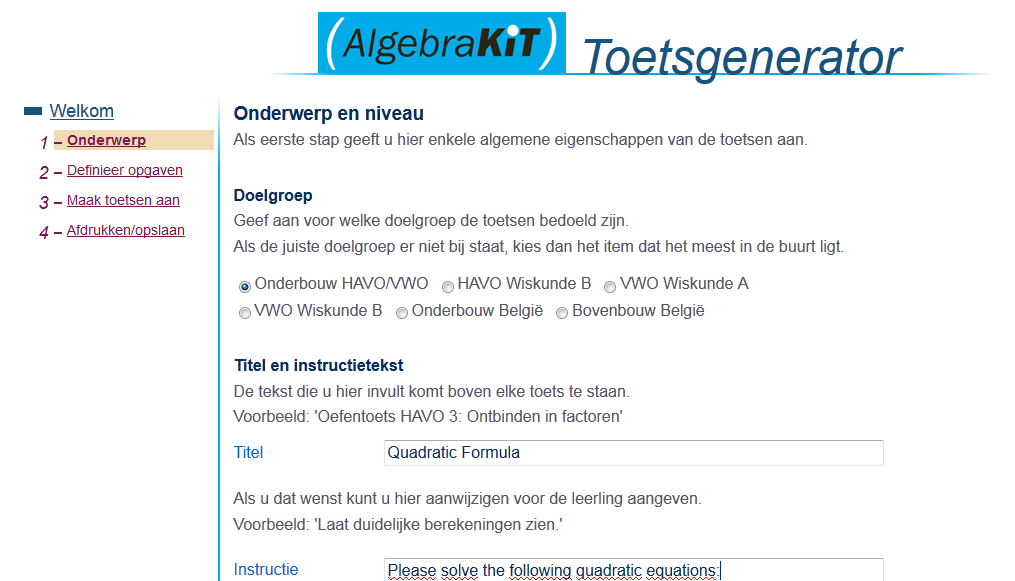
Step 1: general information: first input general information on the test

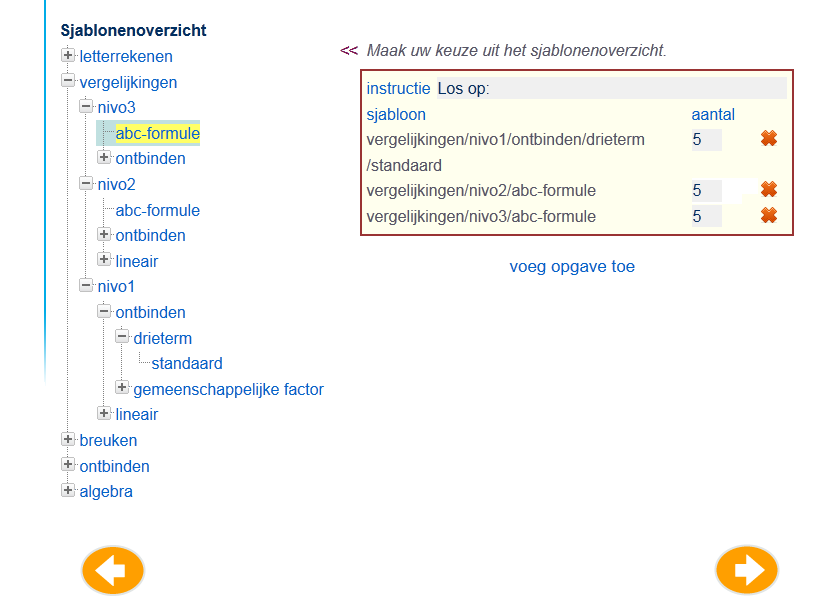
Step 2: choose the level, subject and number of tasks. Note that changing the order of questions seems a bit hard to do.

Step 3: now indicate how many different tests you need

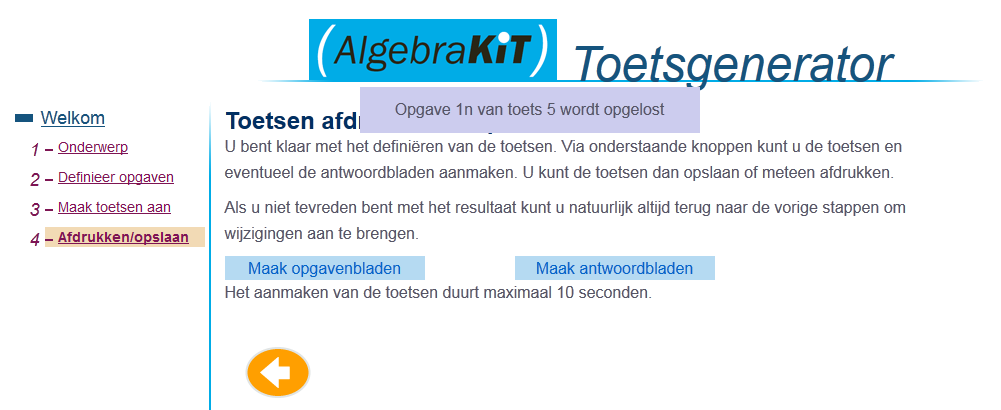
Step 4: clicking “Genereer toetsen” makes the appropriate tests. Clicking “Bereken de antwoorden” generates the answers. This can take a while. Clicking the button shows intermediate steps. You can also choose just to continue.

Step 5: here, finally you can download the task and answer sheets. Nte: for the latter to work you will have to “Bereken de antwoorden”.

Click AlgebraKIT-toets for an example task sheets.
Click AlgebraKIT-toets-antw for the accompanying answer sheets.

Categories
Entertainment Music

Good Old War – After the Party

Categories
Math trivia

Elfenland and Graph Theory

Quite a while back I supervised a class project on graph theory. One inspiration was the boardgame Elfenland. Back then I made quite an elaborate series of lessons involving graph theory and that game. I remembered this because of a tweet involving this post on math strategies for games. Unfortunately I couldn’t find all the documents. On a more modest basis I have recreated some of the activities.

Elfenland is a game that involves using cards to travel from one point to the other. The board is below.

The first step is to transform this board to a graph. There are some difficulties and/or assumption:

  • If one can travel from A to B I have added a vertices and an edge.
  • I did not model any weights or “one way” edges (like 17 to 16, 16 to 15, for labels see below).

I then inputted the graph in Graph Magic (http://www.graph-magics.com/).

Now, assuming that one has to start and end in the capital at vertex 17, It is clear that because of vertex 7, a Hamiltonian circuit cannot be found, as vertex 9 is passed at least twice. So, I excluded vertex 7. Calculating the circuit for the remainder of the graph would suffice, just as long as the player would visit vertex 7 when arriving in vertex 9. The result was:

In this optimal route edges between 17,16 and 15 are not used so the problem of “one way” edges does not have a direct consequence for my strategy. In the next steps weights were added according to the Elfenland rules. In the real game, chance plays a role as travel is done by using playing cards. I have no time to improve it in this occasion, I’ll leave that to you. I think it is a nice introduction to some Graph Theory concepts.

Categories
ICT MathEd

Khan Academy

On the MathEd mailing list I’m on there was some inquiry on Khan Academy. I gave my short description/opinion:

Khan Academy (KA) is often associated with a “pedagogy” denoted as “Flipping the classroom”, which denotes that instruction shifts towards “outside the classroom” through the use of videos, freeing up time for useful classroom discussions, making exercises ín the classroom. Personally I don’t see the novelty in that, as many (good) teachers already use many ways to motivate students. However, at least in de US people seem to take up the movies especially in a homeschooling setting, so perhaps this engagement could be seen as a positive thing. It also depends on the math ed culture in a country.

The movies vary greatly in quality, both mathematically as esthetically. Khan himself has said that the “ugly” movies often were most succesful. Recently -also see documentary 60 minutes- there have been some indications that the movies aren’t watched that well. To improve the content KA has joined up with people like Vi Hart (see http://vihart.com/blog/announcement-khan-academy/) whom we know of the great Pi & Shakespeare movie. As mentioned before, Bill Gates, has taken on Khan as his protege. providing him with ample funds. Because of this backing I think KA probably will have more of a chance to survive the hausse in digital mathematics tools.

A second part of the academy is the exercise section. Good learning analytics, and a great visual map for presenting dependencies and progress in a curriculum. Still, this is the part I am underwhelmed with. A bit too “drill and practice” to my taste. Only answers. This interactive part should, imo., be improved much more.

So, as with many things, a critical view is necessary, but not without acknowledging the positive things.

Categories
Politics

Over de afdrachtregeling van de SP (Dutch)

Om de zoveel tijd is er weer wat commotie rond de afdrachtregeling van de SP. Dit gebeurt meestal als er iemand is die om een bepaalde reden zijn/haar afdracht niet meer doet. Ik draag al jaren mijn wedde af, en heb daarbij nooit het gevoel gehad dat ik geknecht werd door de SP. Afdragen gebeurt door een zg. “cessie” in te vullen die er voor zorgt dat de bijdrage, en nadrukkelijk geen loon is, rechtstreeks naar de SP wordt overgemaakt. Van de SP krijg ik vervolgens 25% van de bijdrage terug op mijn rekening. Het is een vrijwillige keuze, waar ik met open ogen “ja” tegen heb gezegd. Iemand anders kan en mag dat natuurlijk dom vinden, en zeggen dat hij/zij dat zelf nooit zou doen. Prima, natuurlijk, dat moet eenieder zelf weten. Toch worden er soms ook grotere woorden gebruikt om de onwenselijkheid van de afdracht te beschrijven. Zo ook Kees v/d Malen in een artikel in het Haarlems Dagblad.

Het argument dat ik het meeste hoor is die van “Volksvertegenwoordigers horen financieel niet gebonden te zijn aan enige partij, ook niet als dat de partij is die ze vertegenwoordigen.”. Het is dan maar goed dat de SP de afdrachtregeling heeft. Het zijn juist de partijen die geen of weinig afdracht hebben, die een volksvertegenwoordiger afhankelijk doen laten zijn van geld, die daarom ook niet zonder last kunnen beslissen. Immers, als je die paar honderd (of soms in grotere gemeentes meer dan 1000 euro) euro een volgende periode zou moeten missen dan is dat nogal een aderlating. Naar mijn mening zorgt dat voor risicomijdend gedrag; je wilt immers een volgende periode ook weer op die lijst staan. Volksvertegenwoordigers moeten in het openbaar bestuur gaan om iets voor hun omgeving te betekenen, en niet omdat er een wedde tegenover staat. Het is ook niet “een gewone baan” natuurlijk. En ook even logisch beschouwd: is de partij die AFHANKELIJK is niet de partij waar het geld naar toe gaat. Dat is dus de SP zelf die afhankelijk is van haar afdragenden? Ik kan prima zonder last in de raad opereren. Gaat het “fout” dan “mis” ik een volgende termijn maar een klein bedrag.

Een volksvertegenwoordiger moet zonder last kunnen beslissen. Ik constateer dat hier een probleem zit met ons partijenstelsel. Alleen als politieke partij kun je aan verkiezingen meedoen. Personen stemmen op partijen, maar een volksvertegenwoordiger zit volgens de kieswet ook als individu in een vertegenwoordigend orgaan. Dat is natuurlijk een zeer rare situatie. Stel een individuele VVD-er pleit voor communisme in Nederland, na een campagne die gebaseerd is op liberale principes. Dat zou ik gek vinden. Evenzo een SP-er die pleit voor meer marktwerking. Het is volkomen redelijk om van personen op een kieslijst te verlangen dat ze een verkiezingsprogramma onderschrijven. Waarom zou dat nou ook niet kunnen gelden voor de afdrachtregeling? Er worden regelmatig doembeelden geschetst alsof de SP straks eenieders loon, volgens communistisch principe, zou incasseren en vervolgens herverdelen. Wat een onzin. De afdrachtregeling is een duidelijke afspraak die je vrijwillig aan gaat. Je HOEFT het er niet mee eens te zijn.

Ook wordt vaak gemeld dat de SP al een rijke partij is. Dat klopt. Door afdracht, die vrijwillig wordt gedoneerd, verzamel je redelijk wat geld om acties, krantjes enz. te bekostigen. Pardon, mag ik zelf bepalen of ik afdracht voor dat doel goed vind? De reden voor afdracht is niet om zo rijk mogelijk te worden, maar is juist de gedachte dat SP-ers financieel niet profiteren of inschieten bij volksvertegenwoordigend werk. Het is geen baantje waar je een marktconform salaris voor hoort te ontvangen. Je moet het doen om wat voor de samenleving te betekenen.

Natuurlijk zijn er ook grijze gebieden bij de afdracht. Zo kunnen omstandigheden tijdens een termijn in de gemeenteraad opeens veranderen (ontslag bijv.). Hoewel ik dat zelf nooit mee heb hoeven maken, is mijn ervaring dat hier goed over te praten valt met het landelijke bureau. Al is het niet allemaal even duidelijk. Zo is er wel eens een zaak geweest waarbij iemand een dag minder in de week wou werken om haar raadswerk beter te doen. Ze vond het geoorloofd om daarom minder geld af te dragen, want dit zou het verloren salaris kunnen compenseren. Hoewel begrijpelijk, werkt het zo natuurlijk niet. Van tevoren was bekend dat dergelijke verzoeken niet gehonoreerd zouden worden. Als je daar problemen mee hebt, teken dan niet!

Tenslotte is er ook nog zoiets als precedentwerking. Of we het nou willen of niet, mensen zitten nou eenmaal zo in elkaar dat als zij zien en horen dat iemand anders voor gelijk werk meer krijgt dan een ander, dat niet helemaal eerlijk vinden. Misschien had ik mijn geld ook wel willen afdragen aan een goed doel. Toch was van tevoren bekend hoe de regeling in elkaar stak, en als ik daar problemen mee had had ik óf moeten proberen die regels te veranderen (ik vrees dat dit lastig wordt, in weerwil van alle kritiek, zijn de meeste SP-ers vóór de huidige afdrachtregeling) of gewoon niet meedoen. Dat laatste is dan jammer, maar een volkomen geaccepteerde redenering: als je een afspraak niet wilt onderschrijven, dan kun je niet meedoen.

Categories
ICT

Over theCrowdNL (Dutch)

Ik volg via twitter al een tijdje de discussie over het initiatief theCrowdNL. In mijn eigen woorden zou ik het initiatief omschrijven als een netwerkorganisatie die poogt om professionalisering  wat dichter bij de docent zelf te brengen. Zelf schrijven ze op www.thecrowd.nl

The Crowd is een kans voor zelfbewuste onderwijsprofessionals die;

1. Willen excelleren (meesterschap, leren van en met elkaar). Leerlingen laten leren is de grote uitdaging van iedere leraar. Dat vraagt niet alleen om gedegen vakkennis maar ook om meesterschap in klassenmanagement, didactiek en pedagogisch handelen. Dat vraagt vooral om een lerende houding bij de leraar.

2. Vrij willen zijn om eigen keuzes te maken (autonomie, regie over eigen professionalisering). Jij gaat niet zitten wachten tot jouw sectiegenoten in beweging komen of tot de school iets organiseert. Je wilt snel en naar eigen inzicht antwoorden vinden op je leervragen. Je zoekt contact met vakgenoten die…;

3. Een bijdrage willen leveren aan het onderwijs van de toekomst (zingeving, onderwijs 3.0). En wie weet, zet je samen iets in beweging wat veel scholen en de politiek niet voor elkaar krijgen: vernieuwend onderwijs voor de toekomst.

Op 1 februari j.l. is theCrowd officieel gelanceerd, inclusief de nieuwe website, die er overigens erg mooi uit ziet. Ik had al wat kanttekeningen bij het initiatief maar na gisteren zijn die alleen maar sterker geworden. Ik dacht dat het goed was om, hoewel confronterend, dit allemaal eens op te schrijven. Die mening is niet in beton gegoten, maar het zijn wel zaken die mij doen fronzen.

Van 50 naar 500
De ambitie is om pas echt met theCrowd van start te gaan als ze binnen een half jaar van 50 early adopters naar 500 deelnemers gaan. Die arbitraire grens van 500 snap ik niet helemaal. Netwerken kun je met 2 personen al. Waarom zou dit niet kunnen als je maar een handvol personen hebt. Al kun je dan afvragen of een nieuwe organisatie dan de moeite is. Betekent dit dat we nu 50 personen ‘early adopters’ hebben die andere mensen gaan werven die óók 500 euro -want dat staat vermeld op de site- willen investeren? De aanname is dat werknemers professionalisering in eigen handen nemen. Mooi, maar zijn nou juist de mensen die op theCrowd reageren, de personen die dit kunnen, nou net niet die personen die het toch al in eigen handen genomen hebben? Een netwerk met gelijkgestemde personen is dan leuk, maar voegt het dan echt wat toe?

500 euro per jaar
Het is mij ook onduidelijk waarom deelname aan theCrowd überhaupt 500 euro aan investering moet kosten. Gezien enkele reacties op het net wordt gedacht en gevonden dat dit toch een klein bedrag is gezien het geld dat scholen per werknemer uittrekken voor deskundigheidsbevordering. Dat klopt. Je mag er echter wel iets voor terug verwachten, en wat dat dan is, vind ik onduidelijk. Bovendien, als er geen 500 leden komen gaat het niet door, dus óf theCrowd houdt toch op te bestaan, óf we hebben er een netwerkorganisatie bij waar blijkbaar vraag naar is, en waar 500×500=250.000 euro per jaar binnenkomt. Ik vind het onvoorstelbaar om een dergelijk bedrag per jaar te innen en uit te geven. Ik zou het juist zo mooi hebben gevonden als dat nou eens niet nodig was. Nu heb ik begrepen dat het ‘business model’ nog besproken gaat worden. Dat lijkt me goed. Niet vanwege de pecunia’s maar vanwege het idee erachter.

Expertise
Het systeem van experts vind ik ook ondoorzichtig. Gezien het voornoemde “business model”, lijkt het daarmee een grote consultancy-pool waar niet-early-adopters straks hun expertise kunnen halen. Nee, eigenlijk “kopen” want ongeacht wat je haalt of brengt betaal je (investeer je) er 500 euro voor (in). Nogmaals, dat professionalisering geld kost en dat er geld ís klopt vast, maar zelf had ik meer verwacht van het model er achter. Ik las nogal wat tweets die het jammer vonden dat “het weer over geld ging”. Tja, dat krijg je als je een bedrag vraagt zonder duidelijk te maken waar dat bedrag nou voor bedoeld is. Het is flauw om dan criticasters van dit bedrag te verwijten het “over geld te hebben”. Nee, waar het om gaat is, is hoe je je netwerkorganisatie optuigt. Doe dat eens zonder een groot bedrag maar alleen met een administratieve bijdrage, en probeer à la LETS de boel vorm te geven. Een aanname die onder het huidige model lijkt te liggen is dat je voor de beste mensen moet betalen. Ik dacht dat juist “the wisdom of crowds” centraal vond, of de gedachte dat iedereen wel een talent heeft en als we die uitwisselen, dan professionaliseert iedereen.

Consultancy
Wat ik daarbij zelf ook een slecht teken vind is dat de ‘early adopters’ zover ik kan zien vooral bestaan uit personen die”voor hun werk” andere functies vervullen. Ik zag ADE’s (Apple distinguished educators), SCT (Smart Certified Trainers), SEE (Smart Exemplary Educators), APS (consultancy),veel zzp-ers, T3 (Texas instruments), en vast nog meer. Ik zou het geen goede zaak vinden als theCrowd, met zijn kwart miljoen per jaar, activiteiten organiseert door hoofdzakelijk uit deze groep, al dan niet tegen een schappelijker tarief dan de consultancy-fees, experts in te huren. En nee, daarmee zeg ik helemaal niets over de nobele motieven van de initiatiefnemers. Je kunt zeggen: “dat is mooi, want expertise”, en misschien is dat ook wel zo. Ik zou dan graag zien dat die expertise “om niet” zou worden verspreid. Even nog een knuppel in het hoenderhok: theCrowd is toch niet het vehikel om consultants aan klussen te helpen. Voor geld inhuren doe je maar via het andere kanaal, bij theCrowd spelen andere idealen een rol.

Afsluitend
Al met al snap ik theCrowd niet helemaal. De gedachte die ik er eerst over had was dat het oude wijn in nieuwe zakken was: een netwerkorganisatie. Nu de site er is zie ik dat het andere wijn in nieuwe zakken is: een soort consultancypool. Uiteraard snap ik dat mensen zouden kunnen zeggen dat voorgaande allemaal wel heel negatief is. Ik ben van mening dat het punten zijn waar een nieuw initiatief een goed antwoord op moet hebben. Misschien komt dat nog. Waar ik niet zo gevoelig voor ben is opmerkingen dat het “toch goed is dat mensen initiatieven nemen” en “wat zelf mijn bijdrage is”. Met andere woorden “doe zelf dan eens wat”. Gelukkig doe ik dat dagelijks. Hoe het heet? Mijn eigen professionalisering ter hand nemen.