Categories
Math Education Math trivia MathEd

To the 0th power

On twitter I got involved in a discussion on exponents. At first it started with square roots being the same as ‘to the power of 0.5’. The first tweet commented on a blog that stated suprise about the fact that students did not know why the square root of a number was equivalent to ‘to the 0.5th power’. Of course this can be readily proved by using the definition of sum of exponents. I certainly agree with the fact that a lot of students (and teachers?) don’t know why some rules apply. But to me, this is closely related to all the rules that we use. So later on the discussion became more general, and was about when you assume certain properties and when you don’t assume them. For example. proving g^0=1 can be done by using the rule for exponents g^a/g^b=g^{a-b} and so if a=b then g^0=1. But you could also say that, just like g^a/g^b=g^{a-b}g^0=1 could be assumed when proven. If you would state: ‘but I want g^0=1 to be proven from the most basic rules and assumptions’ this seems a fair request.

However, then I would say it is not necessary to assume the rule g^a/g^b=g^{a-b} but that {g^a} \cdot {g^b} = g^{a+b} is enough. Because let a=0 then {g^0} \cdot {g^b} which is (under this law) g^{0+b}=g^b . So {g^0} \cdot {g^b}= g^b and so g^0 must be 1.

Proofwiki has an excellent list of the (inter-)dependency of exponent laws. I know it perhaps is nitpicking if I say ‘assuming less is better’ but some of the rules and laws we commonly use are not always that trivial. For students this is a nice way to approach it. It even has a link to a great question by a student whether we have to define or prove g^0=1. Actually I don’t really care whether you prove it or not, but I do think some ‘feel’ for assumptions, axioms, dependencies etc. is useful for everyone. This was the only point I was trying to make.

A special case involves 0^0 which is indeterminate.

@sndrclsn (who also made this nice picture) tweeted about his great movie bij James Tanton on “zero to the zero”-th power.


It sparked many more musing, like plotting x^y in Wolfram and in Google. But there are other views, like this one stating that 0^0=1 and also the Math Forum has some interesting quotes.

Categories
ICT Math Education MathEd Tools

Teaching kids real math with computers: a comment on Wolfram

Only recently I read this blogpost on a TED talk by Conrad Wolfram.


Although I agree with most in the blogpost, I think Wolfram paints a caricature of mathematics.  Let me make some comments.

I think Wolfram generalizes too much with regard to different countries. I don’t really know that much about the US situation, but I have the impression that procedural fluency and computation are valued much more over there than in Asia or Europe. Something that Michael Pershan also points out in this excellent video. In the Netherlands conceptual understanding is deemed more important, as is the connection to the real world. In this respect Wolfram exaggerates the percentage involved in computation (80% computation by hand).

This brings me to another point. Wolfram is highly involved with some of the developments of Mathematica software (which his brother Stephen created). He even shows it off in his talk. Undoubtedly, Mathematica and Wolfram Alpha are great pieces of software, that can perform awesome calculations. This, however, makes clear that that using a tool to get rid of computation is what is central in his talk, not the other three points.

Mind you, these three steps are very important, and remind me of Polya on problem solving. I just don’t agree with Wolframs fixation on discarding the third point. Wolfram does see a place for teaching ‘computation’ and says we “only [should] do hand calculations where it makes sense”. He also talks about what ‘the basics’ are, and makes a comparison with technology and engineering in cars. Here it would have helped if Wolfram would have acknowledged the difference between blackbox/whitebox systems (see Buchberger, http://dl.acm.org/citation.cfm?id=1095228):

In the “white box” phase, algorithms must be studied thoroughly, i.e. the underlying theory must be treated completely and algorithmic examples must be studied in all details. In the black box phase, problem instances from the area can be solved by using symbolic computation software systems. This principle can be applied recursively.

The whole section where Wolfram addresses criticims of his approach sounds far too defensive. He does not agree with the fact that mathematics is dumbed down, and using computers is just ‘pushing the buttons’. This has to do with the traditional discussion between ‘Use to learn’ and ‘Learn to use’. Again, I think Wolframs whole argumentation is a bit shaky: first he attacks learning algorithms with pen-and-paper , but then he does see a fantastic use regarding understanding processes and procedures. This is where Wolfram applauds programming as a subject. Then he shows many applications with sliders and claims: Feel the math! He shows an application for increasing the sides of a polygon and claims this introduces  the “early step into limits”. By using a slider? I’m thinking of an applet I used in my math class teaching the concept of slopes and differentation. I thought it worked pretty well…until I found out students were just dragging the two points together. So what is actually learned?

As another example, there is a part where Wolfram subtitutes the power 2 with a 4, uses Mathematica, and then says ‘same principles are applied’.
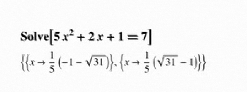
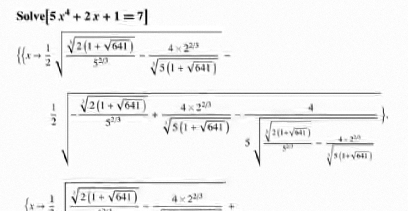
If he means that the same piece of software was used, then this is the same principle. If his claim is that the mathematics behind solving an higher order equation uses the same principles as solving a quadratic equation, then I wonder if this really is the message you want to convey to students. Of course the outside world has much more difficult equations, and that brings me to a final point made, concerning a ‘means to an end’. Wolfram does not define what the actual goal of mathematics is. If it is ‘getting the result’ then one could argue that using a computer over doing it by hand makes sense. However, if -and that was Wolframs claim- the goal is ‘teaching’ then I think mathematics brings more than just some results. Wolfram seems to see mathematics as a supporting science for other subjects, and does not seem to acknowledge a broader view of mathematics as a subject aimed at problem. Which is strange regarding Wolframs initial words on really teaching mathematics.

By no means I’m claiming this is an overly extensive critique of Wolfram’s talk, just a few points that -to me- warrant the conclusion that Wolfram paints too much of a caricature of maths education. I’d rather keep it with the conclusion of the blogpost it started with (translation): “Put aside those textbook with tasks, en tell students what has inspired you to learn your subject. Tell stories. Or get people into the classroom to show inspring examples. Let students look at problems in a different way, and see how they can address these problems with the help of mathematics.”. Amen.

Categories
ICT Math Education MathEd Tools

Storing student work and checking geometry tasks

One of the –in my opinion- most impressive features I have seen in mathematics software is the recent fusion of the Freudenthal Institutes (FI) DME (Digital Mathematical Environment), good content and the ability to plug in components like Geogebra. Of course, it also is software that I know well, because my thesis (www.algebrametinzicht.nl) also used the DME.

For the DPICT project of the FI several lesson series were also translated to English. One of them concerned Geometry. Articles and papers of the project will appear, but I think the material warrants an impression in screenshots.

Logging in as a student:

Accessing the Geometry module:

The geometry module consists of several activities:

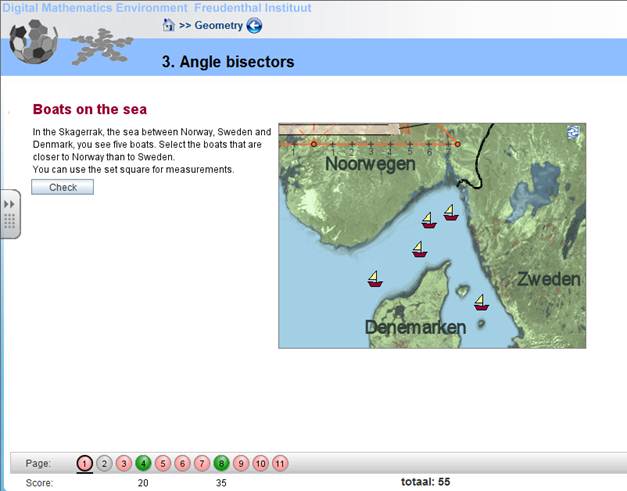
One of the activities starts with a task not uncommon in Dutch textbooks:

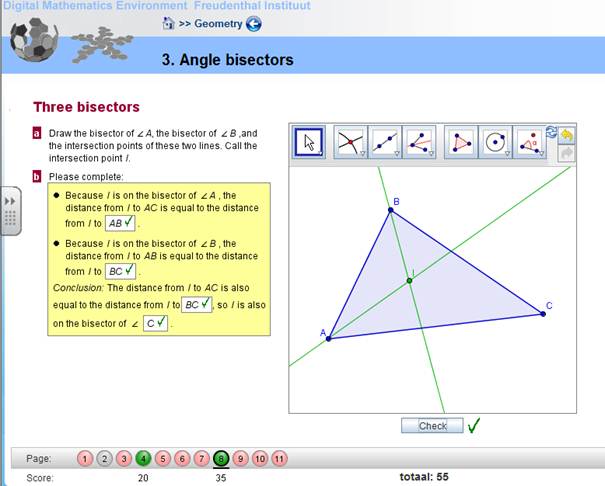
Geometric construction on the right side can be checked. There are open textboxes (which can’t be checked on correct or incorrect, but can be accessed by the teacher). Note that the [c] task, a drop and drag task, was answered incorrectly.

After correcting:

Another task where both constructions and answers are checked:

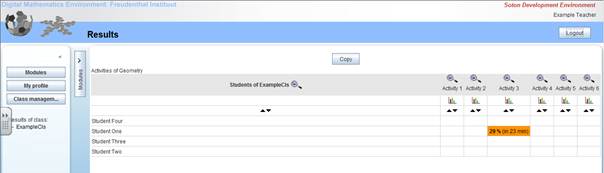
Teachers can see how students performed:

Teacher looks at the task shown earlier:

Categories
ICT Math Education MathEd Tools

Rapid Miner datamining

I recently got into a discussion about datamining. I actually think we have just started to scratch the surface of big data, Learning Analytics and Educational Datamining. As, for example, the Digitale Mathematical Environment (DME, see here), can produce large logfiles of all students’ actions it would be interesting to see if we can find patterns with machine learning techniques. One thing I would like to find out is whether a collaboration with a Computer Science department is possible. I was just dabbling in Rapid Miner, which works and looks great. Using Paren, Automatic System Construction, I trained a sample set of information on Irises. For the future I will see if I can use Rapid Miner. Another option is Weka.

Categories
Math Education MathEd Tools

Algebrakit-toets

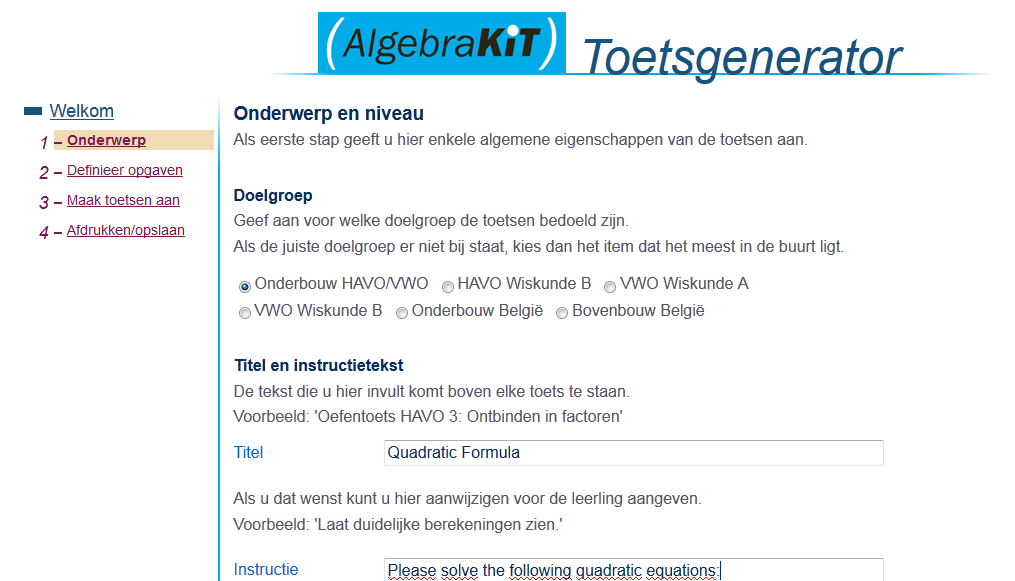
A while back I stumbled on Algebrakit-toets. I never got round to archiving and/or describing it, so here gooes. Algebrakit-toets provides an semi-automatic environment for creating tests and answer-sheets. It can be started here (Dutch, programmer Martijn Slob).

In a wizard-like environment it can:

  • Make tasks for various levels and years.
  • Every student gets a differently randomized test.
  • Every test can be accompanied by an answer sheet

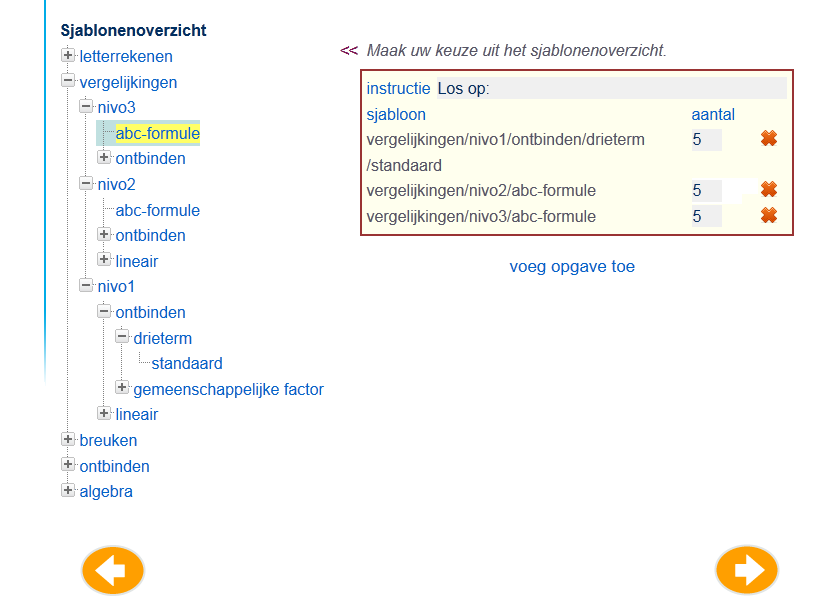
Step 1: general information: first input general information on the test

Step 2: choose the level, subject and number of tasks. Note that changing the order of questions seems a bit hard to do.

Step 3: now indicate how many different tests you need

Step 4: clicking “Genereer toetsen” makes the appropriate tests. Clicking “Bereken de antwoorden” generates the answers. This can take a while. Clicking the button shows intermediate steps. You can also choose just to continue.

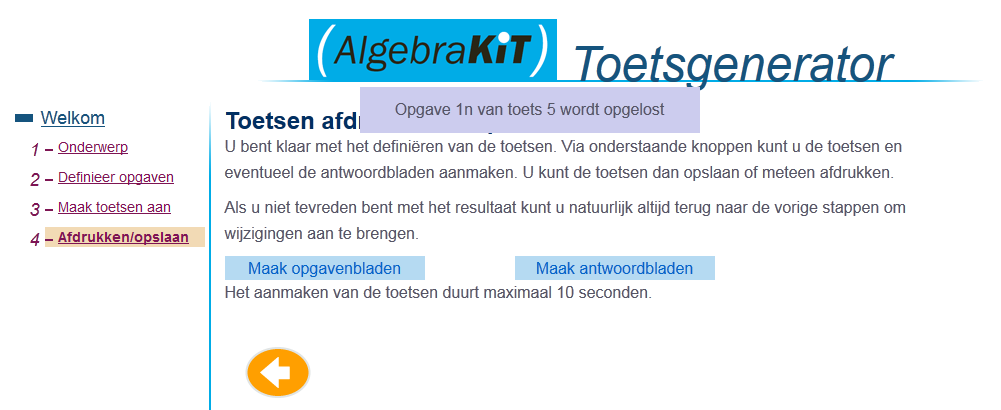
Step 5: here, finally you can download the task and answer sheets. Nte: for the latter to work you will have to “Bereken de antwoorden”.

Click AlgebraKIT-toets for an example task sheets.
Click AlgebraKIT-toets-antw for the accompanying answer sheets.

Categories
Math Education MathEd

A fraction of fractions

On Twitter I encountered a dialogue about the use of fractions, and the question whether we should consider “three tenths” as something different from 0,30 (or 0.30), and whether that differs from 0.3 (or 0,3 ;-). I would think this makes a difference.

Some sources on fractions (only a small selection):

This PhD research was about fractions in primary and secondary education. Unfortunately the thesis is not available digitally. There is, however, a blog where the author has posted some more information.

This document gives an overview of  issues concerning (decimal) fractions on pages 7 and 8, for example place value. In Dutch: this webpage. I also remembered these critical remarks about so-called TAL booklets.
Wu has also written about this topic, and probably more people. Please mention them in the comments!

Categories
Math Education

Khan on homework

In a TED session Khan (yes, of the academy) states that students could watch movies at home and make homework at school. I agree that knowledge transfer, using ICT, could be done more at home. The same however holds for homework (it’s not by accident it is called HOMEwork), again by using ICT. Thirty students working at math tasks sometimes yield only a couple of questions and problems. Why spend 60 minutes of time of students and teachers alike, if this is not necessary. In addition most questions could easily be solved by some prompts or hints from a computer. Shifting knowledge transfer AND homework partly to home (ICT) would free up time in the classroom for more in-depth class discussions, collaborative work and face-to-face contacts.

Categories
Math Education

Peter principle

In mathematics education I roughly see two types of math educationalists (note that I don’t mean these as a disqualification of some sorts):

The first type starts off with a B.Sc or B.Ed degree, M.Sc and M.Ed and maybe even PhD degree in mathematics (education). One could say that de domain knowledge of these indidivuals is outstanding, and their age is still quite young (they could be around 26 finishing all of these). During this career he or she develops an interest in education, sometimes even teaches a couple of years, and is therefore seen as someone with practical experience in education. However, the main aim is to establish a research practice and a mostly a competent teacher (or not) is lost to higher education’s research community, of course playing the shortlived “I have practical experience” card often to establish credibility in the teaching community, but also when applying for grants. I feel this type of expert is part of the peter principle on the practical level, as researching educational practice is NOT the same as performing it. I feel researchers would benefit from a continuing and firm practical experience.

The second type started off with practice, perhaps first starting with teaching and aiding students in mathematics. Liking teaching he or she often picks up a course or two and getting teaching qualifications, and actually being good educators. These establish them as authorities on practice, and then -because everybody is rightly impressed by their teaching- they are asked to explain their succes. This is often done without any research-type basis , but because they are succesful this does not seem to matter. I feel this type of expert is part of the peeter principle on the theoretical level, as performing educational practice is NOT the same as researching it. I feel educationalists (be they in school, ministry or consultancy) would benefit from a continuing and firm theoretical experience.

In sum, I strongly feel that the math (education) community would benefit from bridging practice and theory: specialists in both teaching (actually teaching themselves) AND research (actually performing research themselves). Of course, this is not surprising as it is one of the goals of the Dudoc programme. To join both I think the development of a combination of Veni,vidi,vici type grants and Lector-type appointments in secondary education would be a good thing. About the latter the piece below appeared in the Volkskrant. Of course, I’m perfectly willing to start this up 😉

Categories
Caving Math Education

Portsmouth

In july I will be visiting Portsmouth for a conference. If time permits I will try and visit some heritage sites, e.g. Portsdown.