Categories
Education Research

Economic papers about education (CPB part 2)

This is a follow-up post from this post in which I unpicked one part of large education review. In that post I covered aspects of papers by Vardardottir, Kim, Wang and Duflo. In this post I cover another papers in that section (page 201).

Booij, A.S., E. Leuven en H. Oosterbeek, 2015, Ability Peer Effects in University: Evidence
from a Randomized Experiment, IZA Discussion Paper 8769.
This is a discussion paper from the IZA series. This is a high quality series of working papers, but this -of course- is not yet a peer-reviewed journal version. Maybe there is one at the moment but clearly this version was used for the review. Previously I had already noticed there could be considerable differences between working papers and the final version, just see Vardardottir’s evaluation of Duflo et al.’s paper.
booij
The paper concerns undergraduate economics students. Of course a first observation would be that it might be difficult to generalize wider than ‘economics undergraduates from a general university in the Netherlands’. Towards the end it is however argued that together with other papers (Duflo, Carrell) a pattern results is emerging. The first main result is in Table 4.
mainresult
The columns show how the models were built. Column (1) has the basic model with only the mean of peers’ Grade Point Average (GPA) and ‘randomization controls’ are included. Column (2) adds controls like ‘gender’, ‘age’ and ‘professional college’. Column (3) adds the Standard Deviation (SD) of peers’ GPA in a tutorial group. Columns (1) to (3) do not show any effect. Only in column (4), where non-linear terms and an interaction are added, some significant variables appear. This can be seen by the **. The main result seems rather borderline, but ok, in the context of ability grouping it is Table 5 that is more interesting.
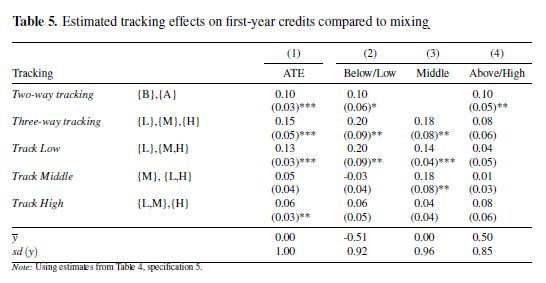
trackingIn that table different tracking scenarios are studied. The first column is overall effects compared to ‘mixed’, so this looks at the ‘system’ as a whole. Columns (2) to (4) show the differentiated effects. From this table I would deduce:
  • In two-way tracking lower ability gain a little bit (10% significance in my book is not significant), higher ability gain a little bit (borderline 5%)
  • Three way tracking: middle and low gain some, high doesn’t.
  • Track Low: low gains, middle more (hypothesis less held back?), high doesn’t.
  • Track Middle: only middle gains (low slightly negative but not significant!)
  • Separate high ability: no one gains.

This is roughly the same as what is described in the article on page 20. The paper then also addresses average grade and dropout. Actually, the paper goes into many more things (teachers, for example) which I will not cover. It is interesting to look at the conclusions, and especially the abstract. I think the abstract follows from the data, although I would not have said “students of low and medium ability gain on average 0.2 SD units of achievement from switching from ability mixing to three-way tracking.” because it seems 0.20 and 0.18 respectively (so 19% as mentioned in the main body text). Only a minor quibble, which after querying, I heard has been changed in the final version. I found the discussion very limited. It is noted that in different contexts (Duflo, Carrell) roughly similar results are obtained (but see my notes on Duflo).

Overall, I find this an interesting paper which does what it says on the tin (bar some tiny comments). Together with my previous comments, though, I would still be weary about the specific contexts.


Categories
Education Research

Unpicking economic papers: a paper on behaviour

One of the papers that made a viral appearance on Twitter is a paper on behaviour in the classroom. Maybe it’s because of the heightened interest in behaviour, for example demonstrated in the DfE’s appointment of Tom Bennett, and behaviour having a prominent place in the Carter Review.

Carrell, S E, M Hoekstra and E Kuka (2016) “The long-run effects of disruptive peers”, NBER Working Paper 22042. link.

disrupt

The paper contends how misbehaviour (actually, domestic violence) of pupils in a classroom apparently leads to large sums of money that people will miss out of later in life. There, as always, are some contextual questions of course: the paper is about the USA, and it seems to link domestic violence with classroom behaviour. But I don’t want to focus on that, I want to focus on the main result in the abstract: “Results show that exposure to a disruptive peer in classes of 25 during elementary
school reduces earnings at age 26 by 3 to 4 percent. We estimate that differential exposure to children
linked to domestic violence explains 5 to 6 percent of the rich-poor earnings gap in our data, and that
removing one disruptive peer from a classroom for one year would raise the present discounted value
of classmates’ future earnings by $100,000.”.

It’s perfectly sensible to look at peer effects of behaviour of course, but monetising it -especially with a back of envelope calculation (actual wording in the paper!)- is on very shaky ground. The paper respectively looks at the impact on test scores (table 3), college attendance and degree attainment (table 4), and labor outcomes (table 5). The latter is also the one reported in the abstract.

table5There are some interesting observations here. The abstract’s result is mentioned in the paper “Estimates across columns (3) through (8) in Panel A indicate that elementary school exposure to one additional disruptive student in a class of 25 reduces earnings by between 3 and 4 percent. All estimates are significant at the 10 percent level, and all but one is significant at the 5 percent level.” The fact economists would even want to use 10% (with such a large N) is already strange to me. Even 5% is tricky with those numbers. However, the main headline in the abstract can be confirmed. But have a look at panel C. It seems there is a difference between ‘reported’ and ‘unreported’ Domestic Violence. Actually, reported DV has a (non-significant) positive effect. Where was that in the abstract? Rather than a conclusion along the lines whether DV was reported or not, the conclusion only focuses on the negative effects of *unreported* DV. I think it would be more fair to make a case for better signalling and monitoring of DV, so that negative effects of unreported DV are countered; after all, there are no negative effects on peers when reported.